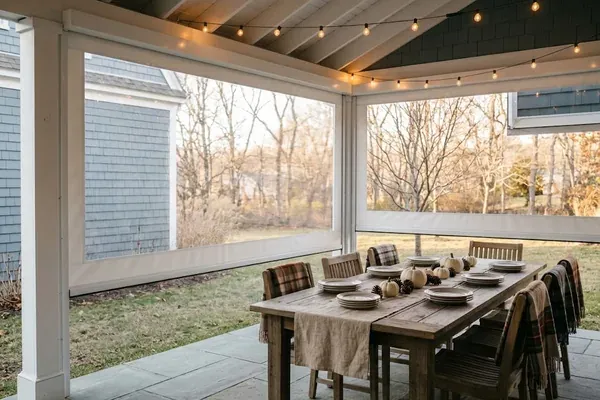
Hosting Outside From Thanksgiving to New Year: A Northeast Patio Plan
Yes, if you plan around the dark, the cold and the food. In 2026, Thanksgiving is Thursday, November 26; Hanukkah runs from sundown December 4 to December 12; Christmas falls on a Friday; and New Year's Eve is a Thursday. In Boston, the sun sets between roughly 4 and 4:30 p.m. through the end of the year, and the average first frost in Central Park is November 20, so most holiday gatherings will run past dark on nights near or below freezing. A covered patio with clear screens, safe heat and good low lighting can host the daylight hours and a cozy evening. Keep cooking and food storage indoors: the USDA's two-hour rule still applies, hot food should stay at 140°F or above and cold food at 40°F or below. Use heat that suits how enclosed the space is, keep candles and any flame away from the clear panels, and have a plan to move inside if a storm is forecast.
Every family has the same moment at a late-fall gathering. Someone looks outside at four o'clock, sees the light going, and says what everyone is thinking: well, that's it for the patio.
It doesn't have to be. Between Thanksgiving and New Year's Day, a Northeast patio can host the part of the day that matters most: the long, slow afternoon before the meal, the kids running in and out, the coffee after. It just needs a plan built around three facts: the sun sets before 4:30, the air is cold, and food has rules that don't care how nice the patio looks.
This is the fourth post in The Cold-Season Patio. The earlier posts covered what ends the season, pairing clear screens with safe heat and storm season. This one puts it all to work on the days you most want to be outside.
The 2026 holiday calendar, against the clock
Start with the dates and the light, because they shape everything else.
Two things follow. First, almost every holiday gathering in this window will run past dark. Second, by Thanksgiving, most of the region is past its average first frost. Even Central Park, which holds out longer than almost anywhere in the Northeast, averages its first frost on November 20, six days before the holiday.
So the question isn't whether your gathering will be in the dark and the cold. It's whether the patio is ready for both.
Build the day around the light
The easiest way to host outside in late fall is to stop treating the patio as the dinner room and start treating it as the afternoon room.
Daylight is when the patio is at its best. The yard is visible, the light is soft and low, and it's usually the warmest part of the day. That's when people want to be outside anyway: drinks before dinner, a game of catch, the walk around the yard.
After dark, the patio can still be part of the evening, just a different part: dessert and coffee under good heat, a quiet hour after the dishes, the conversation that happens when the meal is over and nobody wants to go home.
The same shape works for almost any gathering in this window. Find the sunset time, put the longest outdoor stretch in the two hours before it, and plan for the patio to come back into play after the meal. Guests who know the plan settle in faster, and the cook knows when the kitchen needs to be ready.
You'll notice dinner moved inside. That's deliberate. Big holiday meals involve a lot of hot food, a lot of cold food and a lot of time, and that's the combination the next section is about.
Hanukkah, Christmas and New Year's Eve: three different evenings
Thanksgiving is one long day. The December holidays are different shapes, and the patio fits each one differently.
Hanukkah is eight short evenings. In 2026 it begins at sundown on Friday, December 4, which means every night of it starts well after dark. The patio works best here as a short, warm stop rather than the main event: a half hour outside after the candles are lit indoors, with hot drinks, a heater already running and the low lights on. Short visits are also the easiest to keep comfortable on a cold night.
Christmas Day is an afternoon. It falls on a Friday this year. For many families the patio's moment is between the morning and the meal: a walk around the yard, the kids trying out whatever arrived that morning, a drink outside while the oven does its work. Plan to be inside by the time the light goes, then bring dessert back out if the evening is calm.
New Year's Eve is a long night. It's a Thursday in 2026, and with sunset before 4:30, there are more than seven hours of darkness before midnight. Don't try to hold the whole party outside. Use the patio for a moment instead: turn the heat on twenty minutes before midnight, bring the glasses out, count down under the lights and head back in. It's one of the best uses of a cold-season patio there is.
Food: the rules don't change outside
The U.S. Department of Agriculture's food safety rules are the same on a patio as they are in a kitchen. Hot foods should be kept at 140°F or above, and cold foods at 40°F or below, because bacteria grow rapidly between 40 and 140°F. The USDA's two-hour rule says perishable foods such as meat, poultry, eggs and casseroles left out longer than two hours should be thrown away.
Cold weather doesn't change that, and it creates two traps.
The first is using the cold as a fridge. It's tempting to set the extra drinks, the second pie or the leftover turkey outside on a cold night. The USDA's guidance during winter storms is that storing food outside isn't safe: outdoor temperatures vary, sun can warm food even on a cold day, and food can be exposed to animals. Keep perishables in the refrigerator, and use the cold for drinks if you like.
The second is losing heat fast. A dish that comes out of the oven at a safe temperature cools quickly on a cold patio table. It's still the two-hour rule that governs safety, but it's also why food tastes better served from the kitchen. Bring plates out in rounds rather than setting up a buffet outside.
A simple rule of thumb: cook inside, store inside, serve inside, and let the patio host the drinks, the snacks and the dessert.
Heat, screens and the guest list
The second post in this series covers heaters and clear screens in detail, but a holiday changes the stakes in two ways.
More people means more closing up. On a cold evening with fifteen guests, someone will want every screen down. If you're heating with gas or propane, that's exactly the setup many heater manuals don't allow. Decide in advance which sides stay open if you're using a fuel heater, or use electric heat for the evening. Make that decision before the party, not in the middle of it.
Some guests feel cold sooner, and some feel CO sooner. Older guests and young children get cold faster than the rest of the party, so seat them nearest the heat and furthest from any open side. The CDC has found that carbon monoxide death rates are highest among adults over 65, partly because their symptoms can be mistaken for other conditions. Headache, tiredness or nausea in an older guest at a gathering with a fuel heater running is a reason to turn it off and get some air, not a reason to suggest a nap.
A battery-powered CO alarm on the patio is cheap insurance for a night like this. Test it the day before, along with the heater.
Candles, menorahs and anything with a flame
Holiday light often means real flame: candles on the table, a menorah, a fire table at the edge of the patio. Flame and clear vinyl don't mix well.
Keep every open flame well away from the clear panels and from anything that can catch. Don't set candles on a ledge right next to a lowered screen. If you light a menorah outside, give it a stable, sheltered spot away from the panels, foot traffic and children's hands. And treat a fire table or fire pit the way the second post treats gas heaters: open flame belongs in open air, not on a patio closed in by screens.
Battery candles and string lights do most of the visual work at a fraction of the risk. Save the real flame for where it matters to you most.
Lighting, comfort and the details guests notice
Light before you need it
Turn the low lights on at sunset, not after dark. The patio never goes black, and nobody has to stumble back from the kitchen with a tray. Warm, low, indirect light works best. As the first post noted, a clear panel with bright light behind it reflects some of that light back at night, so several dim sources look better than one bright one.
Warm the people, not just the air
Blankets on every chair. Cushions that have been inside all day, not out in the cold. A rug underfoot, because cold floors pull heat out of feet faster than anything else. Warm drinks within reach. None of it is expensive, and together it changes how long people stay.
Keep the path clear
Holiday gatherings mean traffic: in and out with plates, kids running, guests looking for the bathroom. Keep the path between door and patio clear and lit, and keep heater cords, if you have them, out of it.
The day-before checklist
Most of what makes a holiday patio work happens the day before.
Check the forecast. Look at temperature, rain and wind for the hours you plan to be outside. If a storm is forecast, make the call to move inside now.
Test the heat. Turn the heater on and let it run. A heater that won't light or a breaker that trips is a much smaller problem the day before than with a patio full of guests.
Test the CO alarm. Press the button. Replace the battery if it's been a while.
Clean the clear panels. Fenetex®'s owner's guide says to wash screens with a soft brush and mild detergent, let them dry completely before raising them, and polish clear vinyl with a clear vinyl cleaner such as IMAR 313. Clear panels look their best when they're clean, especially at night with lights behind them.
Set the lights. Put them on a timer for sunset if you can, so nobody has to remember.
Stage the comfort. Blankets folded and ready, cushions inside until guests arrive, a basket by the door for gloves and hats.
The weather backup plan
Northeast holidays come with weather. Nor'easters are most frequent between September and April, according to the National Weather Service, and a big one can arrive on any holiday weekend. The third post in this series covers what to do with insect and shade screens when a storm is coming.
For a gathering, the plan is simpler: decide in advance what moves inside if the forecast turns, and make the call the day before. A patio party that becomes an indoor party with a view of the rain is still a good party. A patio party that becomes a scramble in the wind is not.
What this post won't promise
We can't promise that a particular patio will be comfortable on a particular night. That depends on your cover, your exposure, your heat and the weather, and we haven't measured it for your space.
What we can say is that most of the comfort of a cold-weather gathering comes from planning: matching the patio to the hours it's best for, keeping the food rules, using the right heat for how closed the space is, and knowing when to move inside.
Frequently asked questions
When are the 2026 holidays?
Thanksgiving is Thursday, November 26, 2026. Hanukkah begins at sundown on Friday, December 4, and ends on Saturday, December 12. Christmas falls on Friday, December 25, and New Year's Eve is Thursday, December 31.
What time does it get dark in late November and December?
In Boston, the sun sets between about 4:12 and 4:15 p.m. in the last weeks of November and early December, and between roughly 4 and 4:30 p.m. through the end of 2026, per NWS data reported by the Boston Globe. New York's earliest sunset is about 4:28 p.m. in early December.
Is it safe to keep food outside on a cold patio?
No. The USDA's two-hour rule still applies: hot food should stay at 140°F or above, cold food at 40°F or below, and perishables left out more than two hours should be thrown away. Storing food outside in cold weather isn't safe because outdoor temperatures vary and food can be exposed to animals.
Can I light candles near clear patio screens?
Keep every open flame, including candles, menorahs and fire tables, well away from clear panels and anything that can catch. Open flames belong in open air, not on a patio closed in by screens. Battery candles and string lights are a safer way to get the same glow.
How do I keep guests warm on a patio in December?
Use heat that's safe for how enclosed the space is, close the screens on the sides that take the weather, and seat older guests and children nearest the heat. Add blankets, indoor-warm cushions, a rug and warm drinks. Turn low lights on at sunset.
Where to start
Pick one gathering between now and New Year's and plan it backward from sunset. Decide what happens outside before dark, what moves inside for the meal, and what comes back out for dessert. If the patio isn't ready for this year's holidays, write down what was missing. That list is the start of next year's plan. Most of it can be fixed long before next November.
Sources
Boston Globe. Boston’s last 6 p.m. and 5 p.m. sunsets of 2026. October 16, 2026. bostonglobe.com
News 12. The darkest evening of the year actually happens before winter. November 9, 2023. news12.com
New York Botanical Garden. When should I expect the first fall frost in the New York City area?. 1991–2020 data. libanswers.nybg.org
Farmers’ Almanac. When Is Hanukkah 2026?. 2026. farmersalmanac.com
U.S. Department of Agriculture, Food Safety and Inspection Service. Safe Handling of Take-Out Foods: Holiday Meals, Picnics, Tailgate Parties (archived fact sheet). Archived 2013. fsis.usda.gov (archive)
Food Poisoning Bulletin. USDA Offers Advice for Those Affected by Winter Storm. 2017. foodpoisoningbulletin.com
Centers for Disease Control and Prevention, MMWR. Carbon Monoxide–Related Deaths: United States, 1999–2004. December 21, 2007. cdc.gov
National Weather Service. Nor’easters (winter safety). Current. weather.gov
Fenetex. Owner’s Guide: Retractable Screens. Current. fenetex.com