Clear Vinyl and Heaters: Making a Patio Work Past October
It depends on the heater and on how closed-in the patio becomes. Gas and propane patio heaters burn fuel and produce carbon monoxide, and their manuals typically follow the ANSI Z83.26/CSA 2.37 standard's definition of "outdoors": a covered space with no more than two side walls, or three walls only if at least 30% of the perimeter stays permanently open. Lower clear screens on three or four sides of a covered patio and a gas heater may no longer be in a space its own manual allows. Electric infrared heaters don't burn fuel and produce no carbon monoxide, which is why they're the usual choice for a patio you plan to close in. Whatever you use, follow the manual's clearances, keep heaters away from the vinyl, and know the warning signs: the CPSC lists headache, fatigue, shortness of breath, nausea and dizziness as early symptoms of CO poisoning. If anyone feels them, get everyone into fresh air.
A covered patio with clear screens down and a heater running is the best version of a Northeast patio in November. It's also the version where one wrong heater can turn a cozy evening into a medical emergency.
Clear screens and heat are a pair. The screens close in the open sides while you keep the view; they don't make anything warm. The heater makes warmth; on an open patio, most of it drifts away. Put them together and a 40-degree evening becomes a place you want to sit. But the moment you close a space in, the rules for fuel-burning heaters change, and most people never read the page of the manual where those rules live.
This is the second post in The Cold-Season Patio. The first post looked at what actually ends the patio season in the Northeast. This one covers the two pieces that do most of the work after October: the clear sides and the heat, and the safety rules that tie them together.
What clear screens do, and what they don't
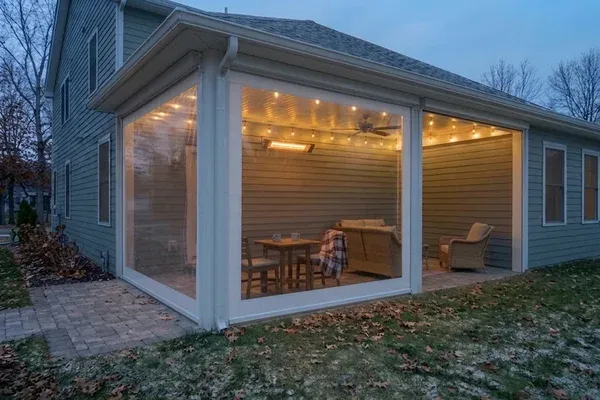
One-Track™ clear screens are the clear member of the One-Track™ line of insect, clear and shade screens. A clear vinyl panel lowers at the press of a button to close in an open side of a covered patio, and disappears into its housing when you don't need it.
That's the job: an open side becomes a closed one, and you're still looking at the yard instead of a wall.
What it doesn't do is generate heat. A covered patio with clear sides on a 38-degree night is still a 38-degree room. That's why the heater question matters so much, and why it has to be answered before the first cold weekend, not during it.
One practical note from Fenetex®'s owner's guide: don't roll the screens up when they're wet. After a damp November evening, that can mean leaving the panels down overnight and raising them once they've dried the next day. It's a small habit, and it belongs in the plan from the start.
The page of the heater manual most people skip
Gas and propane patio heaters are built for outdoor use, and their manuals define "outdoors" precisely. Many follow the ANSI Z83.26/CSA 2.37 standard for gas-fired outdoor infrared patio heaters. Under that definition, a heater counts as outdoors only if its shelter is no more enclosed than one of these:
Now picture a typical covered patio in November. The roof is overhead. One side is the house wall. You lower clear screens on the other three sides. Under that definition, you've built a space with overhead cover and four walls. The heater sitting in the middle of it is no longer in a space its manual allows.
Is a lowered screen a "wall" for this purpose? The standard's language is about the perimeter being permanently open, and a clear vinyl panel that's down is a solid sheet, not an opening. Our reading is that a lowered clear screen counts as a wall. We'd rather be conservative here than clever. If your heater's manufacturer tells you otherwise in writing for your specific setup, follow them. If not, treat the panel as a wall.
A gas heater that's safe on an open patio can be outside its own rules the moment the third and fourth sides close.
Why carbon monoxide is the risk that matters
Every fuel-burning heater makes carbon monoxide. The U.S. Consumer Product Safety Commission describes CO as a deadly, colorless, odorless, poisonous gas produced by the incomplete burning of fuels including propane and natural gas. On average, the CPSC says, more than 200 people in the United States die every year from CO produced by non-automotive consumer products.
Patio heater manuals don't soften it. The standard warning printed on propane patio heaters says that using one in an enclosed space can kill you, and that it should never be used in an enclosed space such as a camper, tent or home.
The timing matters too. The CDC has found that CO exposures and poisonings happen more often in fall and winter, when people use gas heaters and furnaces more, and that the average daily number of CO-related deaths peaks in December and January. That's exactly the season this series is about.
What makes CO dangerous at a gathering is that its early symptoms look like ordinary tiredness. The CPSC lists headache, fatigue, shortness of breath, nausea and dizziness as the first signs of low to moderate poisoning, similar to the flu but without a fever. After a long holiday meal, those are easy to wave off.
Heater types, compared for a patio you plan to close in
Electric infrared: the usual answer for a closed-in patio
Electric infrared heaters don't burn anything, so they don't produce carbon monoxide. Infratech is a good example of the category, and it's the brand that came up when we were planning this series. Its heaters are UL listed for indoor and outdoor use, mount to a wall, ceiling or pole, and need only minimal clearance from combustibles. Infratech describes them as emitting no greenhouse gases or odors and not requiring ventilation.
Infrared also warms people and objects rather than the air between them, which is why it feels warm quickly once it's on. The tradeoff is electrical work. Larger units typically run on 240 volts and may need a dedicated circuit, so you'll want an electrician involved. Plan the wiring before the screens go in and you'll only open the walls once.
Propane and natural gas: fine in the open, limited in an enclosure
Gas heaters put out a lot of heat and need no wiring, which is why they're everywhere. On a covered patio with one or two sides closed, a gas heater used per its manual is within its rules. That's a perfectly good November setup for many homes: clear screens down on the two sides that take the weather, the other side open, and a gas heater placed where its manual says it belongs.
The mistake is closing the last side because it got colder. If you want all sides down, switch to electric heat for those evenings.
Five practical safety rules
Here are the rules we'd put on the fridge. None of them costs much, and together they cover the mistakes that turn a good evening into a bad one.
1. Match the heater to how closed the space is. With a gas or propane heater, keep the patio within the manual's shelter rules, typically no more than two sides closed under a roof. If you want three or four sides down, use electric heat.
2. Respect the clearances, including the vinyl. Every heater manual lists minimum distances to combustible materials. One common propane heater manual, for example, requires three feet from the sides and two feet from the top. Treat your clear panels like any other material that shouldn't get hot, and keep the heater's face pointed at people, not at the screens.
3. Put a carbon monoxide alarm where you sit. A battery-powered CO alarm on a covered patio where any fuel is burned costs little and watches the one thing you can't see or smell. Test it when you test the ones inside.
4. Know the symptoms and act on them. Headache, fatigue, shortness of breath, nausea or dizziness at a gathering where a fuel heater is running means turning the heater off and getting everyone into fresh air. The CPSC's advice is simple: if you suspect CO, get outside immediately and tell a doctor you suspect it.
5. Never improvise with indoor or unvented heaters, and store fuel outside. Don't bring a portable heater meant for indoors onto a closed-in patio, and don't move a patio heater into a garage to warm a party there. Propane heater manuals say to store cylinders outdoors in a well-ventilated space and never in an enclosed area such as a house or garage.
Putting it together: three November setups
Most households will live in the middle row. It's the setup that keeps the damp and the cold coming from the worst direction out while staying inside the rules for most gas heaters. The bottom row is where electric heat earns its cost.
What to look for when you choose a heater
Most heater shopping starts with output and price. For a patio you plan to close in, start somewhere else.
Start with the manual, not the box. Before you buy, download the manual and find two things: the shelter rules and the clearances. If the manual doesn't let you use the heater the way you plan to use your patio, the rest of the spec sheet doesn't matter.
Check the listing. For electric heaters, look for a safety listing that covers the location you have in mind. Infratech, for example, lists its heaters as UL listed for indoor and outdoor use. For gas heaters, the manual will name the standard it's certified to.
Think about where it mounts. A heater on a stand takes floor space and gets moved, which is how clearances get forgotten. A heater mounted high on a wall or ceiling stays where it was installed and stays pointed where it should.
Size it to the seating, not the patio. Infrared warms the people and surfaces it faces. A heater aimed at the table where everyone sits does more than a bigger one aimed at the middle of the floor.
Plan the controls. A heater you can switch on from the door, or one on a timer, gets turned off when people go inside. A heater that needs someone to walk out in the cold to shut it off sometimes doesn't.
Planning the heat before the screens go in
The easiest time to get this right is before installation. If you're talking to a dealer about clear screens for a patio you want to use into December, bring the heat into the same conversation.
Ask where an electric heater would mount and whether there's power nearby. Ask which sides the screens will cover and how that lines up with your current heater's manual. Ask how the housing and tracks sit relative to where a heater would go, so you're not choosing between a screen and a clearance later. A good dealer will have answers or will tell you who does.
If you're starting from scratch, the first post in this series walks through what to fix first, based on where you live in the Northeast.
What this post can't tell you
We can't tell you how warm a particular patio will get with a particular heater. That depends on its size, how exposed it is and the heater's output, and we haven't measured it. Anyone who promises a specific temperature without seeing your space is guessing.
We also can't override your heater's manual. Where this post and the manual disagree, the manual wins. Where the manual is silent on whether a lowered clear screen counts as a wall, we've told you how we'd treat it and why.
Frequently asked questions
Can I use a propane patio heater on a covered patio?
Usually yes, within limits. Many gas patio heater manuals, following the ANSI Z83.26/CSA 2.37 standard, allow use under overhead cover with no more than two side walls, or three walls if at least 30% of the perimeter is permanently open. Check your heater's manual for its exact shelter rules and clearances.
Does a lowered clear screen count as a wall for heater safety?
Our reading is yes. The standard's test is whether the perimeter is permanently open, and a lowered clear vinyl panel is a solid sheet, not an opening. Unless your heater's manufacturer tells you otherwise in writing for your setup, treat a lowered clear screen as a wall.
Do electric patio heaters produce carbon monoxide?
No. Electric infrared heaters don't burn fuel, so they don't produce carbon monoxide. Infratech, for example, lists its electric heaters as UL listed for indoor and outdoor use and not requiring ventilation. Larger units may need a dedicated circuit and an electrician.
What are the symptoms of carbon monoxide poisoning?
The CPSC lists headache, fatigue, shortness of breath, nausea and dizziness as initial symptoms of low to moderate poisoning, similar to the flu but without a fever. If anyone has them where a fuel-burning heater is running, turn it off, get everyone into fresh air, and seek medical help.
Do clear patio screens make a patio warm?
No. Clear screens close in the open sides of a covered patio while keeping the view, but they don't produce heat. On cold evenings you'll still need a heater that's safe for how enclosed the space is.
Where to start
Look at the heater you already have and find the page in its manual that defines "outdoors." Then count the sides you'd want closed on a cold night. If the numbers don't match, that's your answer: either keep a side open or plan for electric heat.
Sources
U.S. Consumer Product Safety Commission. Carbon Monoxide Fact Sheet. Current. cpsc.gov
Centers for Disease Control and Prevention. CDC Report Finds Carbon Monoxide Poisoning Highest During Cold Weather (fact sheet). January 20, 2005. cdc.gov
Centers for Disease Control and Prevention, MMWR. Carbon Monoxide–Related Deaths: United States, 1999–2004. December 21, 2007. cdc.gov
AEI Corporation. Sunglo patio heater installation and owner’s manual (A244, PSA265, A242): definition of outdoors. Undated. gasoutdoorpatioheaters.com
Township of Centre Wellington. Patio heater guidelines (citing ANSI Z83.26/CSA 2.37). Spring 2021. centrewellington.ca
Uline. Propane patio heater manual IH-5839: clearances and CO warnings. Undated. uline.com
Infratech. Comfort Catalog. Undated. infratech (catalog)
BBQGuys. Infratech W-Series 2000W electric infrared patio heater: product details. Current. bbqguys.com
Fenetex. Owner’s Guide: Retractable Screens. Current. fenetex.com
One-Track™. Motorized Retractable Screens for Year-Round Comfort. Current. onetrackscreens.com