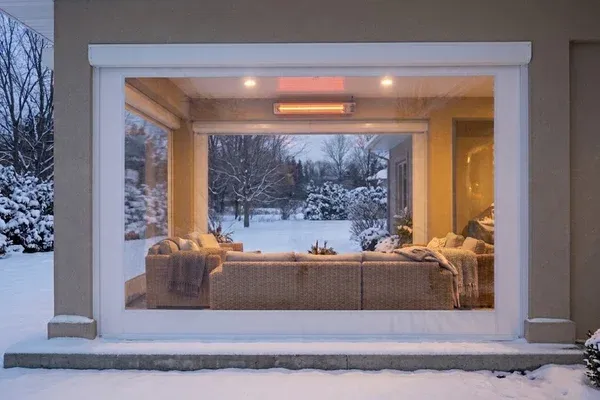
Cold Weather Patio Extension: Why Northeast Patios Go Dark Before They Freeze
In most Northeast metros, darkness ends the patio season before frost does. Since the clocks fell back on November 1, 2026, the sun in Boston sets between roughly 4 and 4:30 p.m. for the rest of the year. The average first frost, by contrast, arrives in late September in places like Caribou, Maine and Concord, New Hampshire, sometime in October at most of the region's major climate sites, and not until November 20 in Central Park (1991–2020 averages). So northern and inland areas lose the season to cold first, while the coastal metros lose it to early dark and raw evenings while temperatures are still above freezing. Extending the season means solving for whichever arrives first where you live: solid overhead cover, sides you can close, a heat source used within its label's safety limits, and lighting for a 4:30 sunset. One-Track™ clear screens close in the open sides of a covered patio while keeping the view. They don't make heat, so on genuinely cold nights you still need a heater.
Most Northeast patios don't close for the season because of the cold. They close because of the clock.
On Sunday, November 1, 2026, the clocks fell back an hour. From that night through the end of the year, the sun sets between roughly 4 and 4:30 p.m. in Boston, according to National Weather Service data reported by the Boston Globe. Meanwhile, the average first frost in Central Park doesn't arrive until November 20. Central Park's average first frost is still more than two weeks away, yet terraces across Manhattan sit empty, because by the time anyone gets home it's dark, damp and colder than the forecast promised.
That gap is the whole story of this post. Before anyone buys a heater or a screen, it's worth knowing exactly what ends the season where you live, because the answer changes the plan. A house in northern New Hampshire and a rowhouse in Newark are living in different seasons in the same week.
This is the first post in The Cold-Season Patio, a five-part series from One-Track News on keeping an outdoor space in use from late October through the holidays.
What actually ends the patio season in the Northeast
Ask people why they stopped using the patio and you'll hear "it got cold." That's true, but it isn't precise, and precision matters here because each cause has a different fix. Three things close a Northeast patio. In the big coastal metros, they tend to arrive in this order.
First, the clock
The last sunset after 5 p.m. in Boston this year came on Halloween, October 31, at 5:39 p.m. The next day the clocks changed and the evening was simply gone. Through the last weeks of November and into early December, Boston's sunsets settle between 4:12 and 4:15 p.m. New York does a little better, but not much: its earliest sunset of the year lands around 4:28 p.m. in early December, per News 12.
That changes who the patio is for. In September it's an after-work room. On a November weeknight it's a room you walk past in the dark. A realistic November patio plan is built around weekend afternoons and gatherings that start at 2 and run past sundown, not weeknight dinners. If a plan doesn't account for the dark, it isn't a plan.
Then, the freeze
Frost dates across the Northeast spread over two full months. The Northeast Regional Climate Center at Cornell University, one of NOAA's regional climate centers, puts the average first fall frost (a low of 32°F or colder) in late September at Caribou, Maine and Concord, New Hampshire, and in mid- to late November around New York City. For most of the region's 35 major climate sites, the average falls sometime in October.
Around New York City, the 1991–2020 averages look like this:
Two things stand out. First, the ranges are wide. Central Park has seen its first frost as early as October 15 and as late as December 22, so an average is a planning number, not a promise. Second, the water matters. Oceans and other large bodies of water push the first freeze later than in the slightly more inland suburbs, according to The Weather Channel's analysis of NOAA data. A terrace in Brooklyn and a deck twenty miles inland can be on different calendars.
And underneath both, the chill you feel
The third thing doesn't show up on the thermometer. The National Weather Service describes wind chill as how cold people and animals feel when they're outside, based on how fast exposed skin loses heat to wind and cold. Your body keeps a thin layer of warmer air next to your skin. Moving air strips that layer away, and you lose heat faster than the reading suggests.
The numbers are blunt. Run the NWS wind chill formula for a 40°F evening with a 15 mph wind and you get about 32°F. On paper it's a cool fall night. On the patio, it feels like freezing.
That's why so many late-fall complaints about patios aren't really about the temperature. They're about raw air, damp, and an evening that felt fine at 3 p.m. and miserable at 5.
Why so many patios sit empty from November on
The pattern isn't unique to the Northeast, but the Northeast feels it hard. In a survey of 2,002 single-family homeowners commissioned by Bromic Heating USA and conducted by Atomik Research, 86 percent said they use their outdoor space much less, or stop using it entirely, during the cooler months. Bromic makes outdoor heaters, so it has a stake in that finding.
A less interested source points the same way. The International Casual Furnishings Association's 2025 consumer survey found that 77 percent of people with an outdoor space underuse it, and only 23 percent use it as much as they want to. That's across the whole year, not just winter.
Here's the finding that cuts against the obvious sales pitch. Interest in heated exterior space fell from 30 percent to 12 percent in the American Institute of Architects' third-quarter 2025 survey, as reported by Qualified Remodeler. People still want to be outside. What seems to be fading is enthusiasm for bolting on another gadget.
The first step in extending a patio season isn't buying something hot. It's working out what actually ends your season, and fixing that.
We'd argue that's the right instinct. A heater on an open, uncovered patio in November spends most of its output warming the sky.
What extending a Northeast patio actually takes
There are four pieces. Most people buy them in the wrong order.
A roof you can count on
Everything else depends on overhead cover. An open pergola lets heat escape straight up, and a clear side panel on a patio with no roof is a window standing in a yard. If your space doesn't have solid cover, that's the first conversation, and it's a conversation for a builder before it's one for a screen dealer.
Sides you can close
This is where One-Track™ clear screens come in. They're the clear member of the One-Track™ line of insect, clear and shade screens. A clear panel lowers at the press of a button to close in an open side, and disappears into its housing when you don't need it.
On a gray November afternoon, that means you can close the open sides and still see the whole yard, then put the panels away the moment the sun comes back.
The point of a retractable panel, rather than zip-up vinyl curtains that go up in October and come down in April, is that it isn't a season-long commitment. On a 60-degree Saturday in early November you leave it up and keep the open air. When the sun drops around 4:20 and the temperature goes with it, the panel comes down.
Heat that's safe for the space you've made
Clear screens close in the sides. They don't make warmth. On most Northeast evenings from November on, you'll want a heat source too, and this is the part to take seriously. Once you close a space in on more sides, the rules for fuel-burning heaters change.
Read the heater's label for its required clearances and for whether it's approved for partly enclosed spaces, and don't guess. The next post in this series covers heater types, clearances, carbon monoxide risk and five practical safety rules in detail.
Light for a 4:30 sunset
It sounds trivial until the first Saturday in November, when the gathering that started at 2 is in the dark by 5. Plan lighting as part of the season, not an afterthought: warm, low, indirect light that keeps faces visible without turning the patio into a stage.
One detail people miss: at night, a clear panel with bright light behind it reflects some of that light back, a little like a window does from inside a lit room. Several dim, low sources usually look better than one bright fixture.
A Saturday in mid-November, hour by hour
Here's what the four pieces look like on an ordinary day. Picture a covered patio outside Boston on the third Saturday of November, with sunset a little after 4:15.
At noon, it's 48 degrees and bright. The clear panels stay up. Coats on, coffee out, nobody needs anything else. This is the stretch of the day most people already use, and they don't need help with it.
By 2:30, the sun is low and behind the neighbor's maples. Down come the panels on the two sides that catch the weather, as long as your installer's cold-weather rule allows it at that temperature. The patio still feels like outside, because it still looks like outside.
At 3:45, the heater goes on: one approved for the space, set where its label says it belongs. Everyone moves their chairs a few feet closer without being asked.
At 4:20, it's dark. The low lights come up. This is the moment that used to end the afternoon, and the moment every piece of this plan exists for.
By 6, you've had six hours outside on a day when most of the street gave up at lunch. That's the whole idea of extending a season. Not a heroic January dinner in a snowstorm. Just the November and December afternoons that would otherwise be lost to the early dark.
Coast or inland: match the plan to your first frost
The four pieces are the same everywhere. The order you buy them in shouldn't be.
If you don't know your own first-frost date, NOAA's National Centers for Environmental Information publishes maps of the median first freeze based on 1991–2020 climate normals. As the date gets close, your local National Weather Service office issues frost and freeze warnings.
Before you call anyone: a five-minute patio check
You can answer most of the questions a dealer will ask before anyone comes out. Walk the space with these in mind.
Cover. Is the roof solid, and does it extend past where you'd want a side panel to come down? Open slats or fabric shade overhead change the conversation.
Exposure. Which sides take the weather? Rain and damp rarely arrive evenly, and most patios have one or two sides that do most of the damage.
Power. Where are the outdoor outlets, and are they where a heater or lighting would need them? Motorized panels and electric heaters both need power, and adding circuits later usually costs more than planning for them now.
Use. When would you actually sit out there in November: weekend afternoons, weeknight dinners, one big holiday? Be honest, because the answer decides how much heat and light you need.
Dates. Write down your average first frost next to November 1. Whichever comes first is the problem to solve first.
What this won't do
A covered patio with clear sides and a heater is not a sunroom. It won't hold heat the way an insulated wall does, and nobody should promise you a specific number of extra weeks. We haven't measured one, and the figures you'll find on other screen companies' sites rarely say how they were measured.
The honest answer is that the gain depends on your cover, your exposure, your heat source and how cold you're willing to sit. What we can tell you is where your season really ends. That's the problem worth solving first.
Frequently asked questions
When does patio season end in the Northeast?
In the big coastal metros, it usually ends with the clock change rather than the freeze. After November 1, 2026, Boston's sunsets fall between about 4 and 4:30 p.m. for the rest of the year, while Central Park's average first frost isn't until November 20. In northern New England, the cold comes first: the average first frost at Caribou and Concord is in late September.
When is the first frost near New York City?
Based on 1991–2020 data, the average first frost is November 20 in Central Park, November 17 at JFK Airport, November 8 in Newark and November 4 in Bridgeport. The ranges are wide: Central Park's first frost has come as early as October 15 and as late as December 22.
What are One-Track™ clear screens?
They're the clear screens in the One-Track™ line of insect, clear and shade screens, installed by certified dealers. A clear panel lowers at the press of a button to close in an open side of a covered patio while keeping the view, and disappears into its housing when it's not needed. They don't produce heat, so on most November and December evenings you'll still want a heat source that's safe for a partly enclosed space.
Why does my patio feel colder than the forecast?
Wind chill. The National Weather Service bases wind chill on how fast exposed skin loses heat to wind and cold. Using the NWS formula, a 40°F evening with a 15 mph wind feels like about 32°F.
Can I use a patio heater behind clear screens?
Only a heater whose label allows use in that kind of partly enclosed space, set up with the clearances the manufacturer specifies. The next post in The Cold-Season Patio series covers heater types, carbon monoxide risk and safety rules in detail.
Where to start
Start with two dates. Look up your average first frost, put November 1 on the calendar next to it, and notice which comes first where you live. That's the problem to solve.
Sources
Boston Globe. Boston’s last 6 p.m. and 5 p.m. sunsets of 2026. October 16, 2026. bostonglobe.com
News 12. The darkest evening of the year actually happens before winter. November 9, 2023. news12.com
Northeast Regional Climate Center, Cornell University. First Frost Fast Approaching. October 8, 2019. nrcc.cornell.edu
New York Botanical Garden. When should I expect the first fall frost in the New York City area?. 1991–2020 data. libanswers.nybg.org
The Weather Channel (via AOL). Fall Is Quickly Approaching: Here’s When To Expect The First Freeze On Average. NOAA 1991–2020 data. aol.com
NOAA National Centers for Environmental Information. When to expect the first fall freeze. 1991–2020 climate normals. ncei.noaa.gov
National Weather Service. Wind Chill Chart. Current. weather.gov
WMAR-2 News. How wind chill is determined. Undated. wmar2news.com
Stacker. Homeowners want more time outdoors. Most backyards aren’t planned for it. (Bromic Heating USA survey). 2026. stacker.com
International Casual Furnishings Association. Do We Adore Our Outdoor Spaces? ICFA Releases New Consumer Research on Porch and Patio Living in 2025. March 24, 2025. icfanet.org
Globe Gazette. Homeowners are investing in year-round backyards even as fire-pit demand cools (citing the AIA via Qualified Remodeler). 2026. globegazette.com
One-Track. Motorized Retractable Screens for Year-Round Comfort. Current. onetrackscreens.com