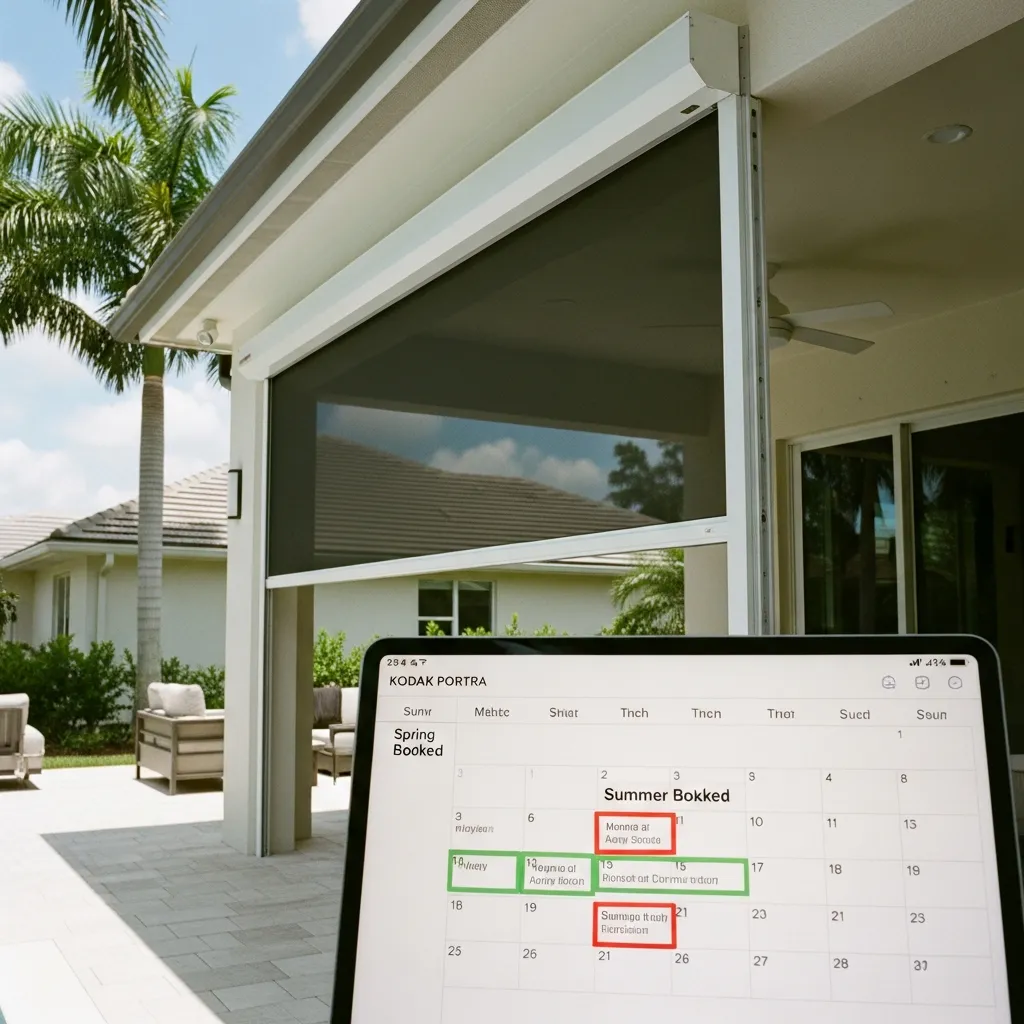
THE SUMMER RUSH NOBODY TELLS YOU ABOUT
"The Calendar Doesn't Lie: What Happens to Dealer Schedules Every Spring"
Call a contractor in February about a summer project, and you might get a callback the same day.
You'll have their attention. Their calendar stretches open before them, slots waiting to be filled, time available for thorough conversations and detailed consultations. They'll answer questions you haven't thought to ask yet. They'll explain options you didn't know existed. They'll treat your project like it matters — because right now, it's one of the few on their desk.
Call the same contractor in June, and you'll get voicemail.
A callback three days later, maybe. An apologetic tone. And a conversation that goes something like this: "We can probably fit you in... let me check... looks like late August, maybe early September?"
This is the summer rush nobody warns you about. Not because it's a secret — it happens every single year, as predictable as the seasons themselves — but because homeowners assume their timing is unique. Their project is different. Their request will somehow skip the line that everyone else is standing in.
It won't. The line doesn't care about assumptions. The line only cares about who joined it first.
The Backlog Nobody Sees Coming
Here's the pattern, invisible until you understand it:
January and February move slowly in the outdoor living industry. Phones ring occasionally. Dealers catch up on administrative work, equipment maintenance, training. The pace feels almost leisurely. A homeowner who calls during these months gets the kind of attention usually reserved for much larger projects — because there simply isn't competition for that attention yet.
Others will call in April. Others will call in May. Others will call too late.
March begins the acceleration. The weather hints at warmth. Homeowners start emerging from winter hibernation, looking at their outdoor spaces with fresh eyes, noticing what they've been ignoring for months. Inquiries tick upward. The calendar starts filling. But there's still room — still time for unhurried consultations, thoughtful planning, flexible scheduling.
April changes everything. Some combination of weather, psychology, and accumulated intention creates a flood. The phones that rang occasionally now ring constantly. The calendar that had gaps now has waitlists. The dealer who could see you next week now talks about next month.
May intensifies the pressure. Every homeowner who "meant to call" finally does — all at once. The demand curve spikes with a violence that defies preparation. No business can maintain February-level attention when May-level volume arrives. Something has to give. What gives is time: time per consultation, time between inquiry and response, time from decision to installation.
June delivers the verdict. "We're booking into August." "September looks more realistic." "Have you considered waiting until fall?" The summer that homeowners imagined enjoying is now the summer they'll spend waiting — watching their patios sit unimproved while the backlog slowly clears.
The cruelest part is the surprise. Homeowners who call in June genuinely didn't know this would happen. They assumed outdoor projects got scheduled when you wanted outdoor projects. They assumed their timeline was their own.
The calendar had other ideas.
Find a One-Track dealer now, before the spring rush begins →
The Numbers Behind the Noise
Industry data paints a stark picture.
Approximately 15-20% of annual outdoor living inquiries arrive in the first quarter — January through March. These are the early planners, the proactive homeowners, the people who understand that timing matters.
Then comes the second quarter: 50-55% of annual inquiries compressed into April, May, and June. Half the year's interest in a quarter of the year's time. And within that quarter, the distribution skews even harder — with the bulk arriving in a six-week window from mid-April through late May.
Picture what that means for any dealer, any contractor, any business serving this market. They staff and plan for relatively consistent demand. Then, in a matter of weeks, demand triples. Quadruples. Every phone line rings. Every email inbox fills. Every available slot disappears.
February caller: "When can you come out?" "How about Thursday?"
June caller: "When can you come out?" "How about August?"
The math isn't complicated. It's just ignored — by homeowners who assume the rules don't apply to them, by procrastinators who believe "later" always means "still fine."
Later doesn't mean still fine. Later means the back of the line.
Some dealers try to manage this through waitlists, priority scheduling, or expanded seasonal capacity. These help at the margins. But no strategy truly solves the fundamental imbalance: six weeks of concentrated demand versus forty-six weeks of everything else.
The homeowners who navigate this successfully don't fight the pattern. They simply avoid it. They call when calling is easy. They schedule when scheduling is possible. They install when installation slots actually exist.
Explore residential solutions while dealers have time to discuss them properly →
What Smart Dealers Know
Talk to dealers who have been in this industry for years, and they'll tell you something interesting: they prefer off-season consultations.
Not because they have nothing else to do. Because quality requires time. Because the homeowner who schedules in February gets a fundamentally different experience than the homeowner who schedules in June — and that difference shows up in outcomes.
More time per project. Better attention to detail. Consultations that breathe.
The February consultation lasts ninety minutes. The dealer walks the space, measures carefully, discusses options thoroughly, answers every question. There's time to consider alternatives. Time to think about edge cases. Time to ensure the solution actually fits the problem.
The June consultation lasts thirty minutes. Not because the dealer cares less — because three other consultations are scheduled that afternoon, and two more tomorrow morning, and the installation crew needs direction on the project they're starting, and the phone keeps ringing with homeowners who just realized they should have called months ago.
Same dealer. Same expertise. Same good intentions. Radically different constraints.
Quality outcomes come from quality processes. And quality processes require something that June doesn't offer: time.
This isn't about being first for the sake of being first. It's about creating conditions where everyone — homeowner, dealer, installation team — can do their best work. Those conditions exist in February. They mostly don't exist in June.
The homeowners who understand this aren't gaming the system. They're working with it. They're recognizing that timing affects more than scheduling — it affects results.
Understand the One-Track customization process that benefits from unhurried attention →
The One-Track Timeline
One-Track motorized screens represent precision engineering. The patented Quiet Spring Technology, the Lock Tight Keder system, the self-adjusting mechanisms that eliminate common failure points — these aren't features that get rushed. They're the result of careful design, careful manufacturing, and careful installation.
That care requires a timeline.
Measured. Manufactured. Installed. Perfected.
The consultation phase establishes what's needed: precise measurements of your space, discussion of your usage patterns, selection of screen types and colors and integration options. This isn't a generic quote — it's a custom specification for your unique situation.
The manufacturing phase builds to that specification. Your screens aren't pulled from a warehouse shelf. They're produced for your space, with your options, to your requirements. This takes time — not excessive time, but real time.
The installation phase brings everything together. Professional installers ensuring proper fit, proper operation, proper integration with your home systems. Testing. Adjustment. Demonstration. Training.
Each phase has duration. Each phase benefits from not being compressed. The homeowner who starts in February gives each phase breathing room. The homeowner who starts in June hopes compression doesn't create problems.
One-Track systems are engineered to last for years, performing flawlessly through seasons and weather and constant use. Giving the installation process adequate time honors that engineering. Rushing it gambles with it.
Learn why One-Track's engineering deserves a thoughtful timeline →
Beating the Rush
The strategy isn't complicated. It just requires acting when acting feels early.
Start the conversation now. Not the commitment — the conversation. The consultation that establishes what's possible, what it costs, what the timeline looks like. Information gathering that puts you in position to decide when you're ready.
Many homeowners resist this step because it feels premature. Snow on the ground, and you're calling about patio screens? But that perceived prematurity is exactly the point. You're calling when calling is easy. When attention is available. When schedules have flexibility.
Schedule the consultation. Understand the options. See the timeline. Then decide.
The decision can come later. The information gathering should happen now. The homeowner who understands their options in February makes better decisions than the homeowner forced to decide quickly in June.
If you decide to move forward, you'll be ahead of the curve. If you decide to wait, you'll wait with full information rather than vague assumptions. Either way, the early conversation produces better outcomes than the delayed one.
One-Track dealers across the country are available for these conversations right now. They're not busy. They're not rushed. They're ready to give your project the attention it deserves — attention that simply won't be available a few months from now.
The rush is coming. It comes every year. The only question is whether you'll be caught in it or ahead of it.
Schedule your consultation before the calendar fills →
The View from Memorial Day
Two neighbors. Same street. Same desire for outdoor improvement. Different timing.
Neighbor A called in February. Consultation in early March. Installation completed in late April. By Memorial Day weekend, the patio is finished, the screens work perfectly, and the first summer gathering is already being planned.
Neighbor B called in May. Voicemail. Callback three days later. "We're booking into August." No consultation until June. Installation scheduled for September. By Memorial Day weekend, the patio looks exactly like it did last summer — unimproved, waiting, another season of "maybe next year."
While others are making calls, you could be making memories.
Same desire. Same neighborhood. Same quality of dealer and installation. Radically different summer experiences — determined entirely by when the phone call happened.
The calendar doesn't lie. It doesn't negotiate. It simply fills, week by week, until the slots are gone and the homeowners who waited discover what waiting costs.
Memorial Day is coming. Summer is coming. The only variable is whether you'll be ready for it — or still waiting for a callback.
The Great Defrost is your window. The calendar is your reality check. And the phone call you make today determines which side of the summer rush you'll be standing on.
Don't wait for the rush. Beat it.
Start your summer on schedule →