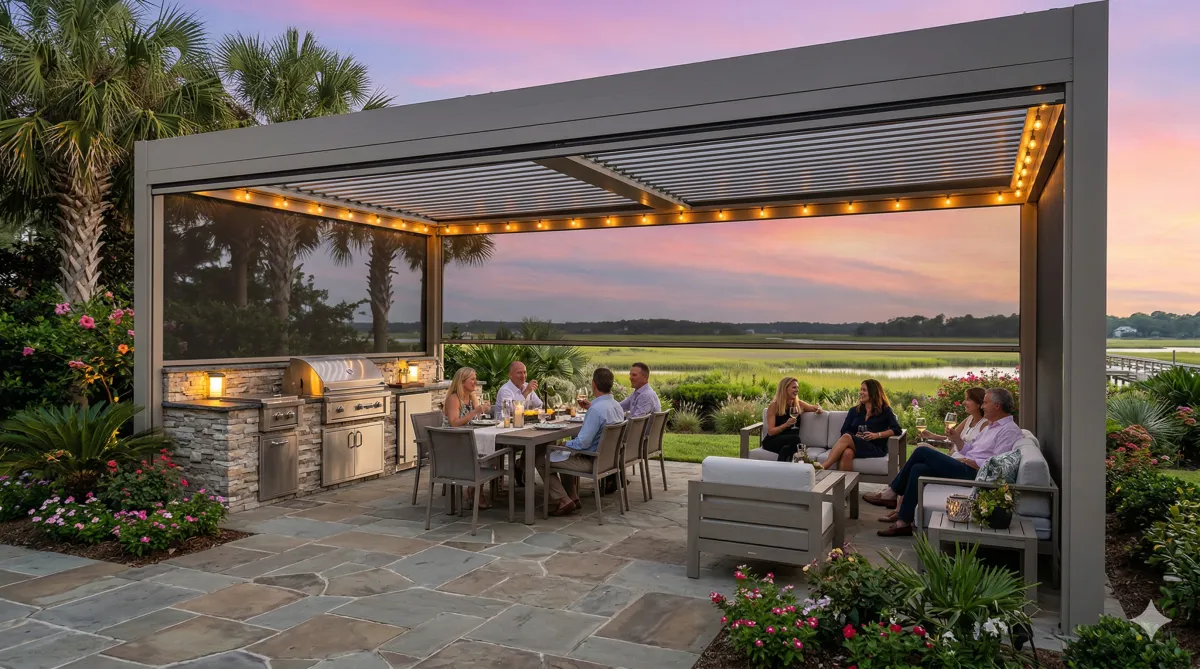
THE INVESTMENT "The Space You're Not Using"
Let's talk about the math that keeps you up at night.
You spent $45,000 on the patio. Stone pavers selected from a showroom where nobody mentioned mosquitoes. The outdoor kitchen cost another $28,000 — Wolf grill, Kalamazoo cabinetry, granite countertops rated for weather that apparently doesn't include insects. The pergola added $15,000, the furniture another $8,000, the landscaping that frames it all another $12,000.
That's $108,000 in outdoor living investment.
Used approximately four months per year. Maybe less, if you count only the hours when bugs don't make usage miserable.
That's not an investment. That's an expensive monument to what could have been.
You walk past it every day. The patio where the parties don't happen. The outdoor kitchen where the cooking doesn't happen. The seating area where the sitting doesn't happen — at least not during the months when sitting sounds most appealing.
The space exists. The usage doesn't. And somewhere in the back of your mind, a number is forming. The cost per month of actual enjoyment. The price per hour of usable outdoor living. The ratio between what you spent and what you received.
The math doesn't lie. And for anyone who wrote those checks believing they were buying a lifestyle, that math is painful.
Bug season is coming. The question isn't whether your outdoor investment will sit unused again — it's whether this is the year you finally get what you paid for.
The Investment That Doesn't Perform
Outdoor living drives real estate premiums throughout the South.
The home with the waterfront patio sells for more than the home without. The listing that mentions "outdoor kitchen" commands more attention than the one without. The photos that show evening entertaining on the lanai generate more clicks, more showings, more offers.
The market recognizes the value. The bugs don't care.
Your outdoor investment cost more than many people's cars. More than some people's weddings. More than the sum total of what many families spend on entertainment in a decade.
And for roughly half the year — the warm half, the half when outdoor living sounds most appealing — that investment generates minimal returns.
$108,000. Four months of comfortable use. The math: $27,000 per month of actual enjoyment. $900 per day. $37.50 per hour, assuming you're outside for the entirety of every usable day, which you're not.
The outdoor space that was supposed to extend your home. The investment that was supposed to pay dividends in quality of life. The lifestyle purchase that was supposed to transform how you live.
Sitting empty. Gathering mosquitoes instead of guests.
Homeowners across the South are finally getting ROI on their outdoor investments. See how →
The Depreciation Nobody Mentions
Outdoor furniture in the South faces challenges that interior furniture never imagines.
Humidity warps wood and breeds mold in cushion foam. UV exposure fades fabrics and cracks finishes. Salt air — even miles from the coast — corrodes metal components. The elements attack your investment from every angle, every day, whether you're using the space or not.
But the worst depreciation isn't physical. It's emotional.
Each season that passes without full use diminishes what the space means to you. The patio you were excited about becomes the patio you walk past. The outdoor kitchen you imagined using every weekend becomes the outdoor kitchen you clean spider webs from in November. The investment that represented dreams transitions into the investment that represents disappointment.
Unused space deteriorates faster than used space — both physically and psychologically.
The grill that runs regularly stays cleaner than the grill that waits idle for months between uses. The furniture that hosts guests stays nicer than the furniture that hosts only humidity and dust. The space that feels like home stays maintained; the space that feels like failure gets neglected.
Your relationship to your outdoor investment changes when that investment consistently disappoints. The walk past the unused patio becomes a walk past a reminder. The glance at the empty seating area becomes a glance at $8,000 in furniture doing nothing. The presence of the space becomes an absence — a hole where the lifestyle you purchased should be.
Extending the Season, Multiplying the Value
What's the cost of actually using your outdoor space?
Not the cost of building it — that check has cleared. The cost of making it work. Of transforming a four-month investment into an eight-month investment. Of reclaiming the summer evenings and spring afternoons and fall weekends that bugs have stolen.
One-Track screens represent the difference between owning outdoor living and experiencing outdoor living.
The math changes dramatically. $108,000 invested in a space you use eight months per year becomes $13,500 per month of value — half the cost per usable period. Add screens to the calculation and the ROI shifts from painful to reasonable.
What's the cost of doubling your usable outdoor months? Whatever screens cost, the math almost certainly works out favorably.
But the real value isn't captured in per-month calculations. The real value is the gatherings that happen, the dinners that occur, the evenings that unfold, the lifestyle that finally materializes.
The outdoor kitchen gets used. The grill earns its cost. The seating area hosts actual sitting. The patio that felt like a disappointment becomes the centerpiece of how you live.
That's not a return on investment. That's the investment itself — the thing you were buying all along, finally delivered.
Residential screening solutions transform how outdoor spaces perform — and how they feel.
Protection Beyond Bugs
Screens protect your outdoor investment in ways beyond keeping bugs out.
The furniture you spent $8,000 on lasts longer when it's not fully exposed to every weather event. Cushions that live inside a screened enclosure resist mold better than cushions that soak in every thunderstorm. Fabrics that stay dry fade slower than fabrics that cycle between wet and sun-baked.
Rain protected. Sun filtered. The investment itself protected.
The outdoor kitchen benefits similarly. The grill that lives under screening stays cleaner. The countertops that avoid the worst of every downpour maintain their finish longer. The appliances that operate in a moderated environment function more reliably than those that face the full assault of Southern weather.
Screens don't just extend usable months — they extend the usable life of everything inside them. The furniture replacement you'd face in five years pushes to eight. The grill maintenance you'd need annually becomes occasional. The ongoing costs of outdoor living decrease because the conditions that drive those costs are moderated.
The initial investment in screens pays dividends in reduced replacement costs for years afterward. The protection compounds.
The Life You Bought
Picture what changes.
The patio you walk past becomes the patio you walk toward. The outdoor kitchen hosts the cooking you imagined. The seating area sees the gatherings you planned when you selected those chairs, that table, that configuration meant for the friends and family you wanted to bring together.
The investment performs. Finally.
The check you wrote wasn't for stone pavers and outdoor-rated appliances. It was for a lifestyle — for evenings under the pergola, for meals from the grill, for the particular pleasure of existing outside in a climate that should reward outdoor living.
The screens weren't part of the original vision. But the life they enable? That was always the point.
Spring arrives and you're outside. Summer persists and you're still outside. Fall extends the season further than it ever extended before. The months when your investment sat unused become months when your investment justifies itself.
That's what getting what you paid for feels like. That's the return you were expecting. That's the lifestyle purchase finally paying its lifestyle dividends.
See the transformation in homes across the South →
Before the Season
The investment is already made. The pavers are laid. The kitchen is installed. The furniture is positioned. Everything about your outdoor living space is ready except the protection that makes it usable.
One more purchase. One more installation. The final piece that transforms what you bought into what you wanted.
Bug season is coming. Another season of looking at your investment instead of using it — unless something changes before the bugs arrive.
Installation during off-peak months is easier, faster, more convenient. The dealers have availability. The timing is controlled. The screens are ready before the first mosquito forces the same old retreat.
Your outdoor investment has waited long enough. The months you've lost are gone. But the months ahead don't have to follow the same pattern.
The space is there. The investment is made. The missing piece is the protection that makes everything else worthwhile.
Bug season is coming. This year, get what you paid for.