THE UPPER MIDWEST & MOUNTAIN WEST
"When 'Seasonal' Means 'Almost Never"
In Denver, they'll tell you the weather can change four times before lunch.
Blue sky at 7 AM gives way to clouds by 9. Sunshine returns at 11, just long enough to coax you outside. By 2 PM, thunderstorms roll over the Front Range with a violence that makes flatlanders gasp. By dinner, the sky is clear again, the mountains catching alpenglow like nothing happened.
In Bozeman, "summer" is a rumor that arrives somewhere around the Fourth of July and vanishes before Labor Day gets its boots on. The winters are legendary, the springs are mud season, and the falls are beautiful but brief — a few golden weeks before the high country turns white and stays that way until May.
Across the Mountain West, homeowners share a common experience: they built beautiful outdoor spaces they barely get to use.
Sixty days. That's what some homeowners calculate as their "safe" patio season. Two months out of twelve. Sixty days where the temperature is comfortable, the wind is manageable, the storms aren't rolling in, and the altitude sun isn't cooking everything in sight. Sixty days to justify the deck, the outdoor kitchen, the fire pit, the furniture, the investment that seemed so reasonable when you wrote the check.
The math doesn't lie. And for anyone who moved to the mountains for the outdoor lifestyle, that math stings.
But here's the question: What if you could pry that sixty-day window open?
What if the mountain lifestyle extended beyond the trails — onto your patio, into October, through the spring thaw and the autumn chill?
The mountains don't compromise. But maybe you don't have to either.
The Shortest Season
The frustration of mountain living isn't that the weather is bad. It's that the weather is everything — intense, dramatic, and completely indifferent to your plans.
Too short. Too windy. Too unpredictable.
You moved here for the outdoor life. The hiking that makes your lungs work and your soul expand. The skiing that justifies every penny of your equipment addiction. The views that stop you mid-conversation because you still can't believe you get to wake up to this every morning.
But there's a difference between outdoor recreation and outdoor living. You can ski in January — you just can't sit on your patio. You can hike in October — you just can't host dinner outside. The activities that brought you here require gear, preparation, exertion. The relaxation you hoped to find on your deck requires conditions that almost never line up.
Sixty days. That's what you calculate. Sixty days of "safe" patio weather. Sixty days out of 365.
The rest of the year, the patio exists as potential. As hope. As the place you'll be when things calm down, when the weather cooperates, when the wind drops and the storms hold off and the temperature lands somewhere between "freezing" and "face-melting."
You wait. And wait. And the season ends before it really begins.
The intense UV at altitude fades your cushions and cracks your materials twice as fast as sea-level sun. The 40-degree temperature swings between afternoon and evening stress every joint, every seal, every mechanism on your patio. The afternoon thunderstorms arrive without warning and leave just as quickly — but not before scattering anything that wasn't bolted down.
The mountain lifestyle promises outdoor connection. It's why people move to Colorado, Montana, Wyoming. But the reality often falls short — not because the landscape fails, but because the weather keeps homeowners trapped behind glass, looking out at the beauty they can't quite touch.
Mountain homeowners are extending their outdoor season from weeks to months. See how →
Extending the Mountain Lifestyle
The traditional response to mountain weather has been acceptance. Locals joke about the intensity with a pride that borders on masochism. "You don't like the weather? Wait five minutes." It's funny because it's true, and it's true because the mountains answer to no one.
But acceptance isn't the only option.
What if you could create a space that acknowledged the mountain's terms while still carving out room for your own? Not a climate-controlled indoor room that pretends the outdoors doesn't exist. Not a massive construction project that takes years and costs six figures. Just a thoughtful boundary — one that blocks wind while letting views through, that stops rain while preserving the smell of pine and approaching storms, that extends your season without disconnecting you from the reason you moved here.
Can you really use a patio in mountain weather? The question assumes the old rules. One-Track rewrites them.
Motorized screens deploy in seconds, creating a protective envelope that transforms exposed decks into sheltered retreats. Wind that would have driven you inside after five minutes? Blocked. Temperature drops that end evenings prematurely? Moderated. The sudden afternoon storm that ruins every outdoor plan? Weathered from the right side of the glass.
The concept isn't fighting the mountains. It's joining them on different terms.
Not a construction project. Not a permit nightmare. Not a six-figure addition. Just screens — engineered for exactly the extremes that define your climate.
Engineering for Extremes
Mountain conditions break inferior products with impressive efficiency.
Temperature swings stress materials in ways that flatter climates never test. Expand at 80 degrees, contract at 35 degrees, repeat daily for months — the thermal cycling that defines mountain weather finds every weakness in every mechanism. Seals fail. Tracks bind. Motors strain against materials that no longer fit the way they did at installation.
One-Track is engineered specifically for this punishment.
Thermal cycling. UV bombardment. Wind gusts. Temperature swings. Handled.
The self-adjusting track system maintains proper tension regardless of temperature. Where fixed-track systems bind in cold and gap in heat, One-Track's spring-balanced design compensates automatically. The screens deploy smoothly at dawn when temperatures hover near freezing, and just as smoothly at midday when the sun has pushed things fifty degrees warmer.
The UV resistance matters more at altitude than anywhere else. Mountain sun isn't just bright — it's intense in ways that accelerate deterioration. At 5,000 feet, UV exposure is 25% higher than at sea level. At 10,000 feet, it's 50% higher. Materials that last a decade in Florida might last five years in Denver. One-Track's fabrics and finishes are built for altitude conditions — the intensity you actually live with, not the mild exposure that specifications often assume.
The wind ratings matter because mountain wind isn't a gentle breeze. Gusts of 60, 70, even 100 mph aren't storm conditions in the Rockies — they're Tuesday. One-Track screens are tested up to 100 mph, means screens that deploy in the morning will still be there when the afternoon winds arrive, unfazed, unflapping, doing exactly what they're supposed to do.
Where others see limits, One-Track sees lines to be redrawn. Where others see seasons, One-Track sees possibilities.
Four Seasons Instead of One
The aspens turn gold, and you're outside.
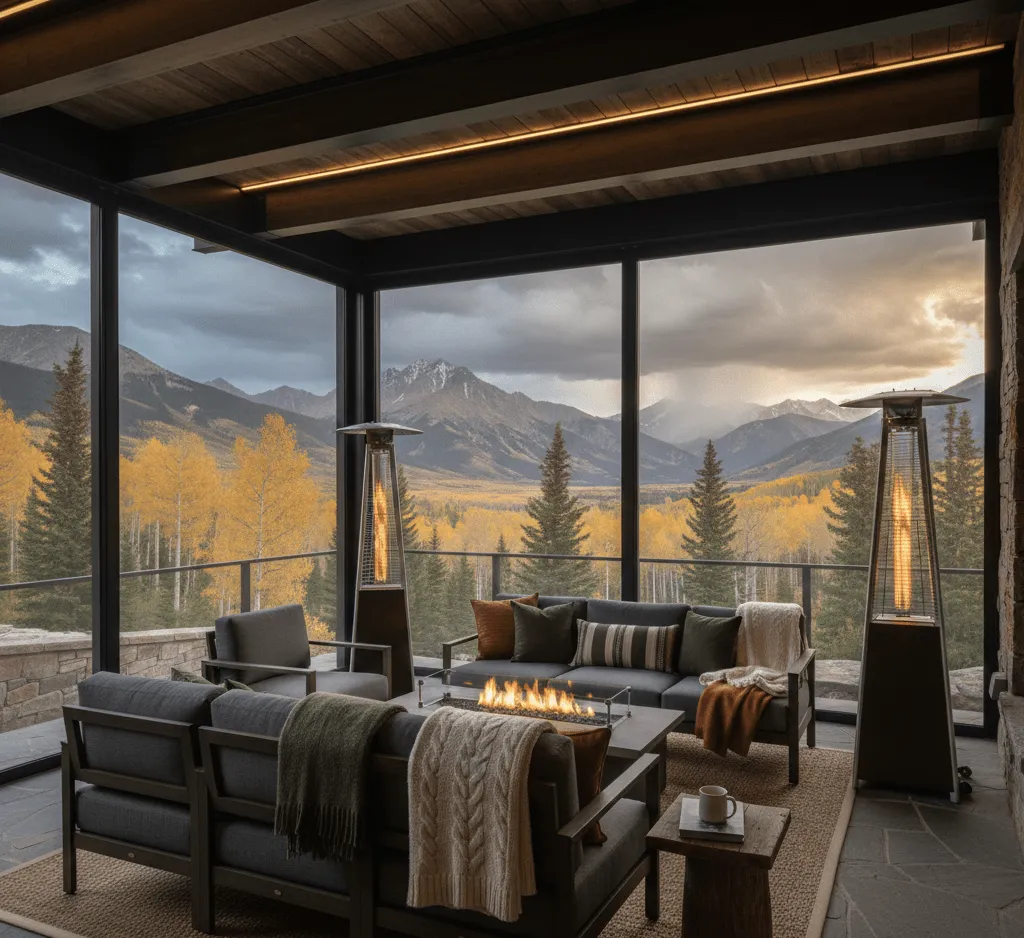
Not just outside in hiking boots, headed for the trailhead. Outside on your patio, blanket draped over your shoulders, watching the last light catch the slopes you'll ski in a few weeks. The air has that October bite, that particular crispness that signals change. But inside your screened enclosure, the outdoor heater takes the edge off. The wind that's stripping leaves from the aspens doesn't reach you.
The first snow falls, and you're still outside.
The flakes drift down, visible through clear screens that frame the view like a living painting. Inside, you're dry. Warm. Comfortable. The contrast between the winter arriving outside and the comfort you've created makes the moment more vivid, not less. You watch the season change from the best seat in the house.
The wind howls, and you're still outside.
Spring, when it finally arrives, no longer catches you flat-footed. The March winds that used to make April outdoor plans laughable? Blocked. The May cold snaps that arrive without warning? Weathered. The season starts sooner and ends later because you're no longer at the mercy of perfect conditions.
The sixty-day season becomes six months. Maybe more. The deck furniture that used to migrate to the garage in September stays where it belongs. The outdoor kitchen that felt like a two-month extravagance becomes a legitimate year-round amenity. The investment finally makes sense.
One-Track draws the line between the untamed and the livable. The mountains don't change. The weather doesn't change. But where you stand when you experience them — that changes everything.
Control at Altitude
Mountain weather moves fast. Your response should too.
One-Track's smart integration means screens can deploy automatically when conditions turn — wind sensors triggering closure before gusts arrive, temperature thresholds activating protection before cold penetrates. The system responds to mountain weather the way you'd respond if you could monitor conditions constantly: proactively, precisely, without hesitation.
You used to watch the weather decide your day. Now you watch the weather while you decide.
Voice control through Alexa and Google means you don't have to leave your seat — or your warm blanket — to adjust protection levels. Smartphone apps mean you can deploy screens before you arrive home, ensuring the patio is ready when you are. Programmable schedules mean your space protects itself during the hours when conditions typically turn, no intervention required.
The technology exists to serve mountain living, not complicate it. Deploy with one button. Adjust with one command. Trust the engineering to handle the rest.
The Invitation
The aspens have turned gold. The first snow dusts the peaks in a way that makes postcards look inadequate. On any other October evening, you'd be inside, looking out, resigned to another season ending too soon.
Tonight, you're on your screened porch, wrapped in a blanket, watching the last light fade behind the Rockies.
The wind that would have driven you indoors? It's out there, making the trees sway in that restless way that signals winter's approach. You can hear it. But the screens hold the line, and you stay exactly where you belong — not inside, not fully outside, but in that perfect threshold space that acknowledges the mountain's power without surrendering to it.
The season extends. Extends through October. Through November. Through everything they said was impossible.
You moved here for the mountains. For the views that make you stop mid-sentence. For the lifestyle that magazine articles romanticize and reality complicates. What you discovered was a landscape that gives everything and demands everything in return — including, for years, most of your outdoor living season.
One-Track doesn't negotiate with the mountains. It doesn't pretend the weather is something other than what it is. It simply creates a space where you and the mountains can meet on terms that work for both of you. The view stays wild. The wind stays blocked. The lifestyle you came here for finally extends to your own backyard.
The season everyone else surrendered? You're still living it.
Extend your mountain season. Find a dealer →