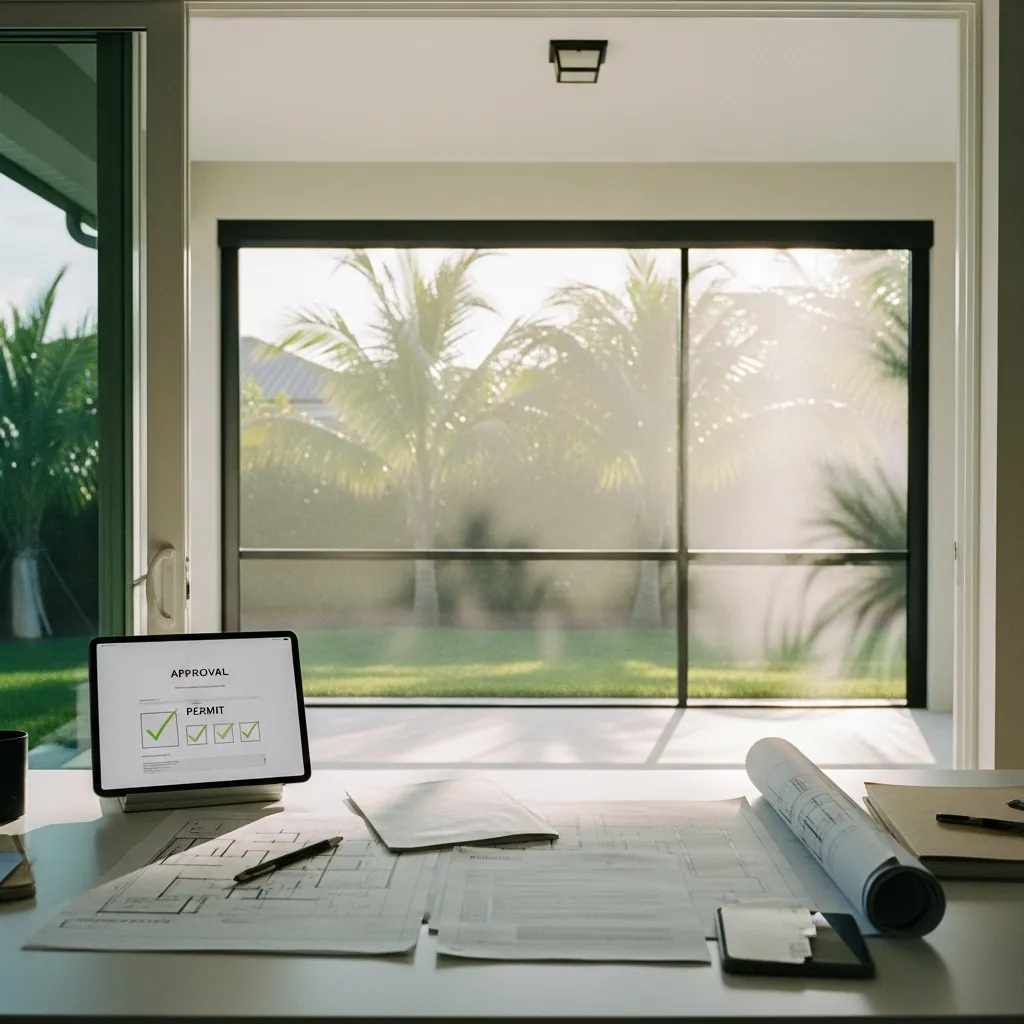
PERMITS & PAPERWORK
Permits & Paperwork: Navigating the Bureaucracy Before the Spring Rush Clogs the System
If the Great Defrost is the window of opportunity, then bureaucracy is the dust on the glass.
Most homeowners think of a patio screen installation as a physical act—the drilling of tracks, the mounting of housings, the wiring of motors. They visualize the gleaming finish of the frames and the smooth glide of the mesh. But for many, the physical act cannot begin until the "paper act" is complete. Patio screen permits, HOA approval outdoor project requirements, and zoning for patio enclosures are the invisible hurdles that can turn a three-week project into a three-month ordeal. These administrative steps are the gatekeepers of your summer comfort.
In February, the local building department is just like the contractor’s office: quiet. The halls are empty, and the permit technicians are looking for files to process. In May, however, the permit office becomes a swamp of applications for pools, decks, and massive home additions. This is the building department spring rush that traps the unprepared. If you wait until the first bird chirps to submit your paperwork, you aren't just waiting on a contractor; you are waiting on a government employee with a stack of files two feet high, struggling to manage permit lead times that have tripled overnight.
Understanding the patio screen project schedule means realizing that a signature is just as vital as a screwdriver. When you act during the quiet months, you ensure that contractor paperwork help is readily available and that your application doesn't get buried in the pile. You are effectively clearing the path so that when the ground thaws, your only focus is the transformation of your home.
Explore how early planning ensures a seamless transition—visit the One-Track homepage.
The HOA Hurdles: Why February is Your Best Friend
If you live in a community with a Homeowners Association, you know the board doesn't move with "summer speed." They operate on a deliberate, often glacial, cycle. Most boards meet only once a month, and their agendas are packed with landscaping disputes and budget reviews. They have specific, rigid requirements for color, height, and "visual impact" that can stop a project in its tracks.
If your application for HOA approval outdoor project status is missing even one minor detail—a fabric sample, a site map, or a spec sheet—it gets kicked to the next month’s meeting. Starting in February gives you the "correction buffer." It allows you to fail early and recover quickly. If the board has questions about how One-Track screens look when retracted, you have the time to provide high-resolution photos from the Gallery & Ideas page to prove they are virtually invisible and won't disrupt the community aesthetic.
Navigating zoning for patio enclosures through an HOA requires a storyteller’s touch and a technician’s precision. By submitting your plans now, you aren't rushing the board; you are giving them the respect of time. You can answer their questions about motorized screen lead times and material durability without the frantic energy of a looming construction date. By the time the HOA board is overwhelmed with a hundred different pool fence requests in April, your approval is already in your pocket, signed and sealed.
Zoning and the "Spring Clog"
Building departments are, by their very nature, seasonal businesses. They mirror the heartbeat of the construction industry. In the dead of winter, they are processing indoor renovations and basement finishes—low-volume, predictable work. But in the spring, the "Clog" begins. Every outdoor project in the county, from the smallest shed to the most expansive residential solutions, hits their desk at once.
A permit that takes five days to approve in February can easily take five weeks in June. This is the building department spring rush in action. It is a mathematical bottleneck that no amount of wishing can bypass. Navigating these bureaucratic hurdles early ensures that when your customized system is ready to be installed, the city isn't the thing standing in your way. You are effectively "buying" time when it is cheapest to do so.
When you understand how to get HOA approval for motorized screens and municipal permits simultaneously, you eliminate the friction that bogs down your neighbors. You want your installer's only job to be the installation—not chasing down a clerk for a signature while the summer sun is beating down on an empty patio. By handling zoning for patio enclosures while the office is quiet, you ensure your project is at the front of the line, ready for the first available installation window.
Find out how One-Track residential solutions are designed to meet local standards.
Engineering Docs and Precision
High-quality systems like One-Track often require specific engineering data for patio screen permits—wind load ratings, electrical requirements, and mounting specs. This isn't just "red tape"; it’s about ensuring the safety and longevity of your investment. One-Track technology is engineered to the highest standards, featuring the patented Quiet Spring Technology and the Lock Tight Keder system, but you still need to get that data into the hands of the right people.
February is the ideal time to gather these "boring" but essential documents. Your dealer can provide the technical specs for the patio screen project schedule without the stress of a looming deadline. When you provide the building department with professional, detailed engineering docs, you reduce the likelihood of a "request for information" that delays your project by weeks. You are speaking the language of the inspectors before they are too tired to listen.
Precision in paperwork leads directly to speed in execution. By detailing your smart home integration plans and electrical needs now, you ensure the permit covers every aspect of the build. Whether it’s patio screen permits or HOA approval outdoor project specs, having the engineering data ready shows that you are a serious homeowner with a serious plan. It turns a complicated approval process into a simple formality.
Understand the engineering that sets us apart—Why One-Track.
The Cost of a "Stop Work" Order
There is nothing more expensive than a project that starts without a permit and gets shut down mid-way. Imagine the scene: the tracks are halfway up, the sun is shining, and a city inspector pulls into your driveway because a neighbor called or they saw the truck. The "Stop Work" order is a summer-killer. The fines are one thing; the delay is another.
If a project is halted in June because of patio screen permits issues, you might not get it back on the schedule until August. The contractor moves on to the next "legal" job, and you are left with a half-finished patio and a looming legal headache. By handling the patio screen project schedule logistics now, you are buying insurance against this worst-case scenario. You are ensuring that "The First Day" of summer is spent on your patio, not in a lawyer’s office or a city council meeting.
Don't let a "Missing Signature" steal your summer. When you plan your smart home integration logistics now, you are vetting the electrical and structural requirements ahead of time. You are ensuring that every part of the HOA approval outdoor project is documented. It’s about peace of mind. It’s about knowing that when the screens go down for the first time, they are there to stay, fully backed by the law and your community.
The Professional Advantage
Dealers and installers love homeowners who handle paperwork early. It makes their job significantly easier and allows them to manage their motorized screen lead times with total confidence. When you show a dealer that you already have your HOA approval outdoor project letter or your city permit in hand, you move to the top of their "Preferred" list.
You aren't just a lead; you are a "green light" project. In a world of "maybes" and "waiting-on-the-board" clients, be the homeowner who is a "definitely." This professional advantage often translates into better installation dates because the dealer knows they won't have to reschedule you due to a permit delay. They can slot you into that first week of May because the patio screen permits are already in the folder.
Take the time to customize your screen options so you can include the exact specifications, colors, and dimensions in your permit application today. When you provide the board with a clear vision of your Gallery & Ideas inspired project, you make it easy for them to say yes. You are providing them with a professional package that reflects the quality of the One-Track system.
The Peace of the Paper-Free Summer
Imagine the feeling of May’s arrival. The air is warm, the trees are budding, and you feel the first true pull toward the outdoors. You look at your patio and see that the permit is already taped to the window. The HOA has sent their "Approved" letter months ago. The contractor has the green light, and your materials are already staged in the warehouse.
You have no more "administrative" tasks left. Your only job is to watch the screens go up and the summer begin. Bureaucracy is only a hurdle if you try to jump it at the same time as everyone else. By handling patio screen permits and HOA approval outdoor project details in the off-season, you've already won. You’ve navigated the building department spring rush before it even started.
Handle it in the off-season, and the paperwork becomes a non-issue. It becomes a distant memory of a productive February. This is the ultimate payoff of the Great Defrost: the ability to sit back and enjoy the "First Day" without a single worry about zoning or board meetings. Start your summer on schedule and leave the "Spring Clog" to the neighbors who waited.