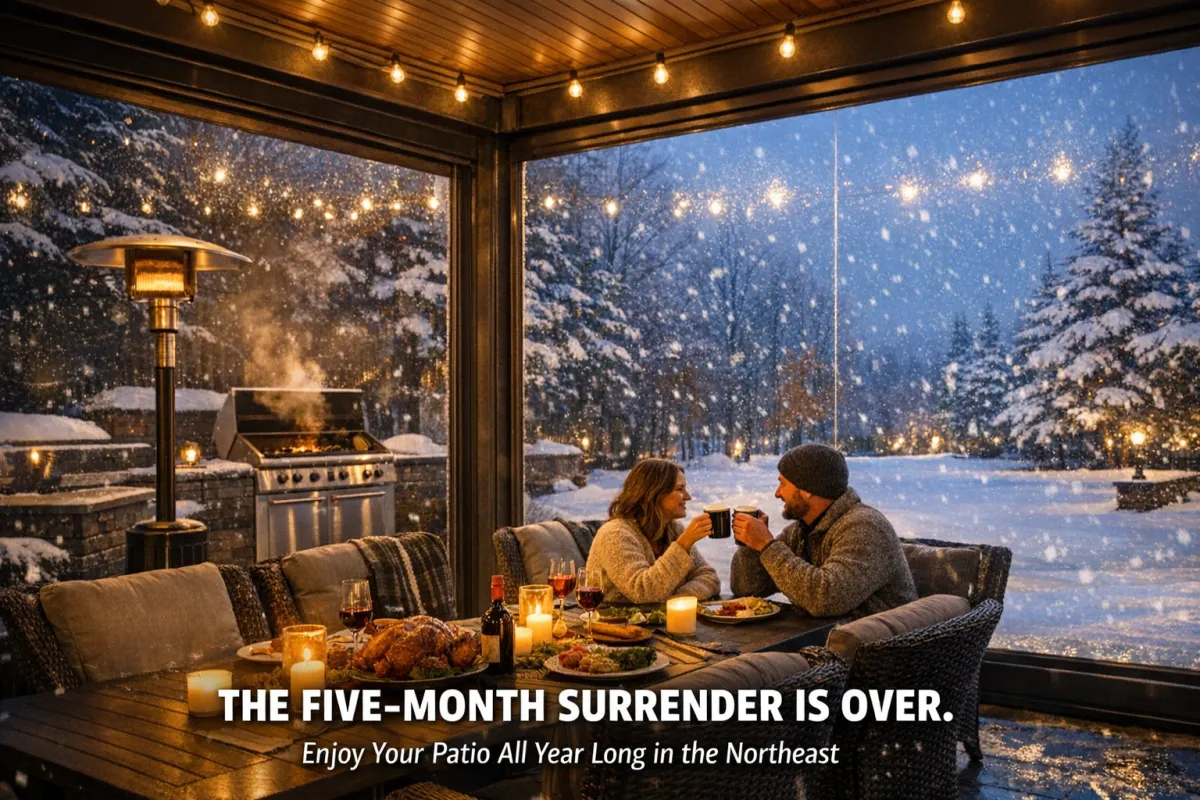
The Five-Month Surrender
"The Five-Month Surrender"
There's a ritual in the Northeast. Sometime around the first week of October, homeowners perform a slow, reluctant surrender. Cushions come inside. Grills get covered. The patio furniture stacks in the garage like refugees from a season that left too soon. For the next five months, the space that hosted summer's best moments sits empty — a monument to what was, a reminder of what won't be until May.
The numbers tell a familiar story. From November through March, the average patio in Boston sits unused for 150 days. In Minneapolis, that number stretches to 180. In Buffalo, homeowners joke darkly about their "six-month winters" while watching snow accumulate on outdoor kitchens that cost more than their first cars. Across the region, patios worth $30,000, $50,000, even $100,000 hibernate beneath tarps and snow, waiting for a warmth that feels impossibly distant when February winds cut through everything.
But here's the question no one asks: What if that surrender was optional?
If we can string Christmas lights in July, host "Christmas in July" sales, and wear ugly sweaters in summer for laughs — why can't we flip the script? Why can't we claim a little summer in December? Why can't we step onto our patios on a crisp November evening and stay there, comfortable, protected, watching the last golden leaves fall while sipping something warm?
The answer, for most homeowners, has always been simple: because we can't. Because the wind cuts through. Because the cold penetrates everything. Because "outdoor" and "winter" are mutually exclusive concepts in climates where lake-effect snow buries entire neighborhoods overnight.
Until, that is, someone draws a different line.
The Weight of the Surrender
The five-month surrender isn't just about weather. It's about something deeper — a frustration that settles into Northern homeowners like frost into the ground.
You planned the gathering. You checked the forecast. You moved everything inside anyway.
Year after year, the same pattern repeats. Labor Day arrives, and with it, that familiar sinking feeling. The countdown begins. Six weeks, maybe eight, before the patio becomes unusable. Before the space you designed for connection and relaxation gets handed over to the elements like rent you never agreed to pay.
The financial math stings when you stop to calculate it. That $50,000 outdoor kitchen? If you use it five months a year, you're paying $833 per month for the privilege. The stone patio with the built-in fire pit? Sitting empty for more than half its existence. The investment was permanent. The enjoyment? Seasonal at best.
But the real weight isn't financial — it's emotional.
There's the Thanksgiving that could have been on the patio, watching the first snow fall through warm windows that don't exist. There's the December birthday party pushed inside because "it's just too cold out there." There's the New Year's Eve toast you imagined raising under the stars, relocated to a living room that suddenly feels cramped with everyone who showed up.
Northern homeowners learn to lower their expectations. They learn to say "next summer" so often it becomes reflex. They learn to look at their patios through winter windows and feel something between resignation and loss — the quiet grief of watching something you love become inaccessible, month after month, year after year.
Why should weather dictate how you live? It shouldn't. And with the right solution, it doesn't have to.
See how homeowners across the Northeast are transforming their outdoor spaces →
Redefining "Outdoor Season"
The traditional solution to winter patios has always been construction. Add a sunroom. Build a four-season room. Enclose the porch with permanent windows and call it an addition. The results can be beautiful — and the price tags can be staggering.
A proper sunroom addition in Massachusetts runs $80,000 to $150,000. In Minnesota, where insulation requirements are stricter, costs climb higher. Then there's the timeline: permits that take months, contractors booked a year out, construction that disrupts your home for an entire season. By the time the addition is finished, you've missed another winter of outdoor enjoyment.
But what if there was another way?
Not a construction project. Not a permit nightmare. Not a six-figure addition that takes two years to complete. Just screens — motorized, retractable, engineered for exactly this moment.
The concept is simple: create a protective envelope around your existing patio that blocks wind, stops precipitation, and moderates temperature — all while preserving your view and your connection to the outdoors. When conditions are pleasant, the screens retract completely, invisible, letting you enjoy the open air you designed your space for. When the wind picks up, when the temperature drops, when the weather turns hostile, the screens deploy at the touch of a button.
The result isn't an indoor room pretending to be outdoor. It's an outdoor room that decides, on your terms, how much of the outdoors to let in.
Clear vinyl screens create a barrier that keeps the cold out. Temperature inside a screened patio can run 10-15 degrees warmer than the exposed air outside — enough to transform a 45-degree November evening into something comfortable with a simple patio heater. The wind that would have driven you inside in five minutes? Blocked. The view of the changing leaves, the falling snow, the winter landscape you actually love? Preserved.
This isn't about fighting winter. It's about drawing a new line — one where winter stops, and your space begins.
The One-Track Difference
Not all screens are created equal. In the Northeast, where conditions punish inferior products mercilessly, the engineering matters.
Traditional retractable screens rely on zipper systems — the same technology that struggles with your jacket in cold weather. Zippers catch. They jam. They fail precisely when you need them most, leaving you wrestling with stuck fabric while the wind laughs. In climates where temperature swings can stress materials and moisture can freeze in mechanisms overnight, zipper-based screens become maintenance headaches at best, expensive failures at worst.
One-Track takes a fundamentally different approach.
The patented Lock Tight Keder system eliminates zippers entirely. Instead, a precision-welded edge slides into an engineered track and locks into place — no teeth to misalign, no fabric to catch, no mechanism to freeze. The result is a screen that deploys smoothly in any weather, every time, without the failures that plague conventional systems.
Then there's the Quiet Spring Technology at the heart of every One-Track system. Traditional motorized screens fight against their own weight, creating noise, vibration, and uneven deployment. One-Track's spring-balanced system works with the motor, not against it, producing near-silent operation that feels almost magical. The screens descend. Descend in silence. Silence that feels like permission to finally exhale.
For Northern homeowners, the engineering details translate into daily reliability:
No jams. No blow-outs. No service calls. No surrender.
The powder-coated aluminum frames resist the corrosion that salt, snow, and freeze-thaw cycles inflict on lesser materials. The self-adjusting tracks maintain perfect tension regardless of temperature swings — no expansion gaps in summer, no contraction binds in winter. Wind tested up to 100 mph mean the screens that protect you in November will still be protecting you when March winds howl.
This is what engineering for real conditions looks like. Not screens designed for California and sold in Massachusetts. Screens built to thrive where winter isn't a season — it's a way of life.
Life After the Surrender
Picture Thanksgiving on your patio.
The leaves have fallen. A few stubborn ones cling to the oak tree at the edge of your property, rust-colored against a gray November sky. The air outside carries that particular bite that usually sends everyone scurrying for the warmth inside — sharp, insistent, the kind of cold that finds its way through coats and sweaters and good intentions.
But you're not inside. You're on your patio, and so are twenty-two of your closest family members.
The clear screens descended an hour before the first guests arrived. The outdoor heaters have been running, warming the enclosed space to a comfortable 65 degrees. Through the vinyl panels, you can see your neighbor's patio sitting empty, furniture long since stored, cushions moldering in their garage. But here, inside the envelope you've created, the table is set. Wine is poured. The turkey is carved.
And through those clear screens, the first snowflakes of the season begin to fall.
This isn't fantasy. This is Tuesday.
In November, you're still outside. When the first snow falls, you're still outside. While your neighbors retreat behind their windows, you're still outside.
The surrender is over.
The furniture that used to spend five months in your garage? It stays where it belongs. The outdoor kitchen that felt like an extravagance you could only justify for half the year? Working overtime. The gatherings you pushed inside, the dinners you rescheduled, the moments you lost to weather? Reclaimed.
Your investment finally matches your intention. Your outdoor space finally works the way you imagined when you wrote that check. Your home finally extends beyond its walls, even when — especially when — the world outside turns cold.
December morning coffee with a view of snow-covered pines. January dinner parties that don't feel cramped inside. February sunrise yoga in a space that feels outdoor but doesn't feel frozen. The calendar hasn't changed. The weather hasn't changed. Only the boundary has moved — and with it, everything.
The threshold you never knew you could draw — between the bitter wind and the space where you belong. One-Track doesn't fight winter. It simply tells winter where to stop.
Control at Your Fingertips
The best technology disappears into your life. It doesn't demand attention; it delivers results.
One-Track integrates with the way you already live. A single button deploys or retracts your screens — no apps required if you prefer simplicity. But for those who want more, the system connects seamlessly with smart home platforms that put control exactly where you want it.
Heading home from work on a cold November evening? Deploy your screens from the car so the patio is protected and warming by the time you arrive. Hosting a dinner party and want the screens down before guests arrive? Schedule it. Watching the weather turn while you're in another room? Voice command through Alexa or Google handles it without you leaving your seat.
You used to check the weather before making plans. Now you make plans and let the weather check itself.
The integration goes deeper than convenience. Smart sensors can trigger automatic deployment when wind speeds rise or temperatures drop below thresholds you set. The screens respond to conditions so you don't have to monitor them. Your patio protects itself while you focus on living.
This is what control feels like — not fighting against your environment, but orchestrating it. Not reacting to conditions, but setting terms in advance. The weather does what it does. One-Track ensures you're always ready.
The Invitation
For five months every year, you've accepted an arrangement you never agreed to. Weather decided when your outdoor living ended. Cold drew a line you couldn't cross. The patio you invested in sat empty while you watched through windows, waiting for a spring that felt like it would never arrive.
The arrangement is over. The line has moved.
Imagine Thanksgiving on your patio. The leaves have fallen. The air outside is sharp, carrying that particular November bite that sends most people scurrying indoors. But inside your screen-enclosed space, the table is set. The outdoor heater glows warm. Your guests raise glasses to a view you thought you'd lost until spring — the bare branches, the first flurries, the quiet beauty of early winter.
This isn't next year. This isn't someday. This is the winter that's already coming, met with a solution that's already here.
For generations, Northern homeowners have accepted the five-month surrender as inevitable. The calendar dictated when outdoor living began and ended. The weather drew boundaries that felt permanent, immovable, natural. But boundaries, it turns out, are only permanent until someone draws new ones.
One-Track draws that line. Between the wind and your warmth. Between the cold and your comfort. Between the patio you invested in and the months you've been missing.
The surrender is over. The season extends. Step outside.
Find a One-Track dealer near you →