THE GULF COAST & DEEP SOUTH
The Bugs Won. Or Did They?
In Florida, they call it "the lanai" — that screened outdoor room that's practically a birthright in the Sunshine State.
Look at any Florida real estate listing and you'll see it: "Beautiful lanai overlooking the pool." "Spacious screened lanai with lake views." "Entertainer's dream with extended lanai." The lanai isn't a feature in Florida — it's an expectation. A requirement. The baseline for what outdoor living means in a climate that promises tropical ease and year-round warmth.
But here's the truth no one puts in the real estate listing: even with screens, the bugs find a way.
The no-see-ums don't knock. They don't wait to be invited. They find the gaps your old screens pretend don't exist, and they settle in like they own the place.
Gaps appear where frames meet. Mesh warps and stretches in the humidity. The tiny terrors that Floridians call "no-see-ums" slip through standard screen mesh like it isn't there — which, for insects that small, it might as well not be. And when hurricane season arrives, those screens become liabilities — torn, destroyed, replaced, repeated.
Homeowners across the Gulf Coast know the cycle intimately. The screens gap. The zippers fail. The bugs find a way.
Fight the bugs. Lose to the storms. Rebuild. Repeat.
What if there was a different cycle?
The Bug Battle You're Losing
The Florida lanai represents a promise. Outdoor living, tropical ease, the good life under swaying palms with a drink in hand and no particular place to be. When you bought the house — or moved to the state, or invested in that outdoor renovation — the lanai was part of the vision. The reason. The point.
When that promise breaks down, something deeper breaks too.
And the mosquitoes come, and the no-see-ums follow, and the guests start swatting, and the evening ends earlier than planned.
The numbers on Florida's insect population are staggering, but they don't capture the daily reality. What captures the daily reality is this: you set up a beautiful evening on your lanai, you invite people you care about, and within twenty minutes everyone is either slapping at exposed skin or making polite noises about "getting late" and "early morning tomorrow."
You know the screens aren't working. You can see the gaps. You've watched the no-see-ums drift through mesh that supposedly keeps them out. You've tried everything — different sprays, citronella candles, fans supposedly creating air barriers — and nothing fully works because the problem is structural. The screens themselves are failing at their basic function.
Traditional screens fail against tiny insects because traditional screens weren't designed for tiny insects. Standard mesh keeps mosquitoes out (mostly). It does nothing for no-see-ums, gnats, and the other minuscule tormentors that make Gulf Coast outdoor living an exercise in frustration.
Traditional screens fail against weather because traditional screens were designed for gentle conditions. Florida doesn't do gentle. Hurricane season runs June through November — half the year — and tropical storms, afternoon thunderstorms, and the violent squalls that roll off the Gulf don't wait for your screens to be ready.
The screens gap. The zippers corrode. The bugs win. Again.
Gulf Coast homeowners are ending the bug battle for good. See insect screen solutions →
Sealed Systems vs. Traditional Screens
The problem with traditional lanai screens isn't the material — it's the architecture.
Traditional screens rely on zippers, seams, and frame connections that inevitably create gaps. When the screens are new, those gaps might be minimal. After a Florida summer of humidity, UV exposure, and thermal cycling? The gaps grow. The zippers corrode. The mesh stretches. What started as a minor imperfection becomes a highway for anything small enough to exploit it.
Traditional screens have gaps. One-Track has boundaries.
The Lock Tight Keder system represents a fundamentally different approach. Instead of zippers — which corrode, which jam, which fail precisely when you need them — the screen edge is precision-welded into a Keder bead that slides into an engineered track and locks. No teeth to misalign. No fabric to catch. No gaps.
The seal is continuous. From top to bottom, from side to side, the screen meets the track in a connection that doesn't leave room for compromise. No-see-ums can't exploit gaps that don't exist.
Is there really a screen that stops no-see-ums? There is now. The Lock Tight Keder system doesn't leave room for doubt — or insects.
The mesh options make the difference even more dramatic. Standard screen mesh has openings around 18x16 per inch — fine for mosquitoes, useless for no-see-ums. One-Track offers fine mesh options that stop the tiny insects while maintaining airflow and visibility. The technology exists. It's just a matter of deploying it properly.
Motorized operation adds a layer of convenience that transforms how you use your lanai. Traditional screens are permanent — they're either there or they're not. One-Track screens retract completely, giving you full openness when conditions are pleasant and complete protection when they're not. The flexibility means you're not choosing between bugs and breeze. You're choosing both, exactly when you want each.
Engineering for Tropical Climates
The Gulf Coast breaks products with casual efficiency.
Humidity corrodes mechanisms. Salt air accelerates deterioration. UV exposure degrades materials at rates that engineers in northern climates never anticipate. And then there's hurricane season — six months of potential destruction that turns any outdoor investment into a gamble.
One-Track is engineered to thrive in exactly these conditions.
No gaps. No zippers. No jams. No failures. No bugs.
The marine-grade powder coating on every aluminum component isn't an optional upgrade — it's standard. The same corrosion resistance that protects boats in salt water protects One-Track screens in the relentless humidity of coastal Florida. Years from now, while your neighbor's screens have pitted and corroded, yours still operate like new.
The wind ratings matter because tropical weather doesn't ask permission. One-Track screens are tested for 100 mph winds — strong enough to handle the gusts that accompany summer thunderstorms, strong enough to remain deployed when lesser screens would be shredding.
The self-adjusting track system handles humidity fluctuations that would jam fixed-track systems. Expand in afternoon heat, contract in evening cool, adjust to the constant moisture that defines Gulf Coast air — the tracks maintain proper tension regardless of conditions. No binding. No stuck screens. No service calls to fix problems that shouldn't exist in the first place.
Sealed at the edges. Strong in the wind. Silent in operation.
The Lanai That Finally Works
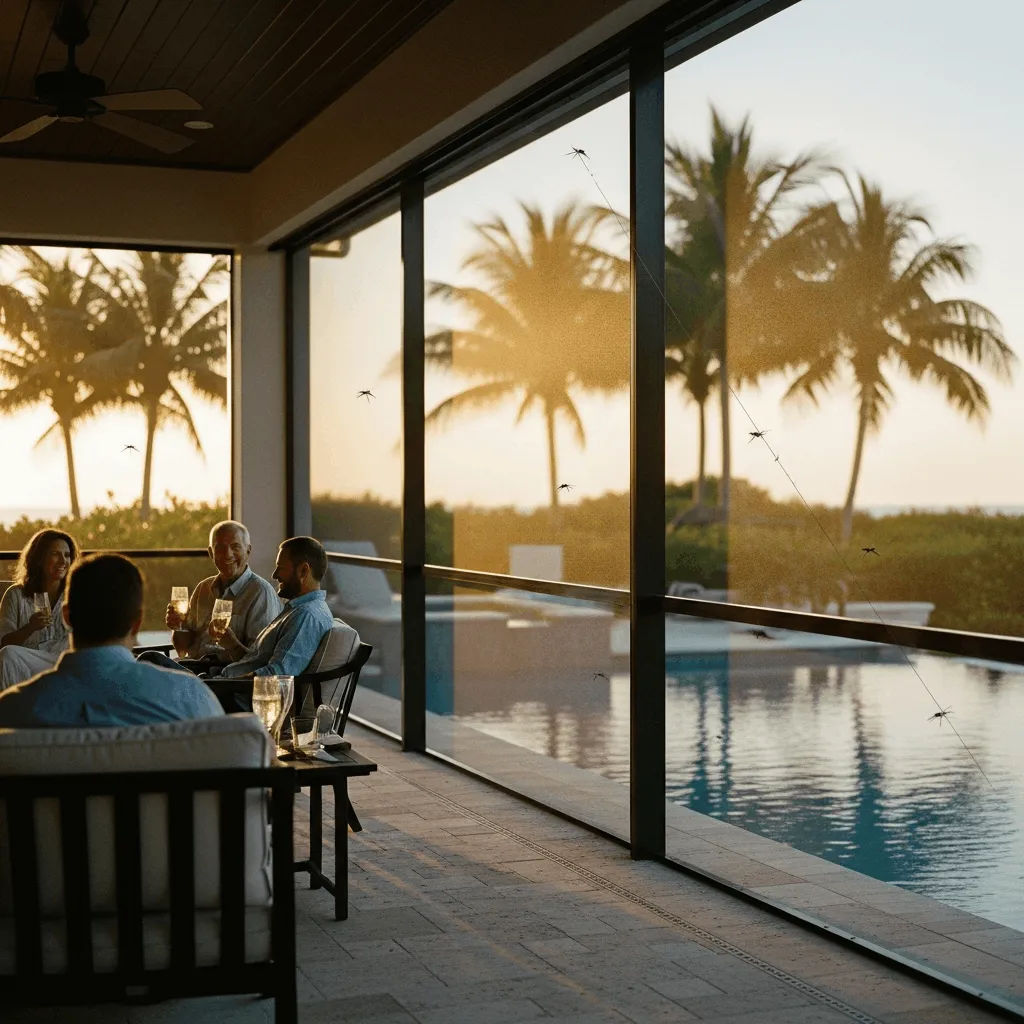
Picture sunset on the Gulf.
The air is warm, soft, alive with the sound of insects you can hear but cannot feel. The palm fronds sway in a breeze that reaches your lanai without bringing the bugs that usually ride it. The pool reflects colors that make this exact moment the reason you moved to Florida in the first place.
Your guests linger. Nobody is swatting. Nobody is making excuses to leave early. The evening lasts. The guests stay. The bugs? They stay out.
The lanai is doing what the real estate listing promised. What you imagined. What you paid for.
The evening extends past sunset into that blue Florida twilight. Someone refills glasses. Someone else suggests dinner should happen right here, right now, why go inside? The conversation continues because nothing is interrupting it. No invisible teeth on exposed ankles. No high-pitched whines near ears. No surrender.
The threshold holds. Where traditional screens leave gaps for nature to exploit, One-Track draws a line that doesn't break. The bugs stay out. The storms stay out. You stay exactly where you belong — in your sanctuary.
This is Florida the way the brochures promised. The outdoor living that justified the move, the investment, the life you're building here. Finally delivered.
No swatting. No retreating. No surrender.
Storm-Ready Living
Hurricane season runs half the year. Your screens should be ready for all of it.
One-Track's motorized operation means deployment takes seconds. When the afternoon sky darkens and the wind picks up, when the weather service issues warnings, when storm season does what storm season does — protection is a button press away.
Storms used to threaten your screens. Now your screens answer the storm.
The smart integration takes readiness a step further. Weather alerts can trigger automatic deployment. Wind sensors can close screens before gusts arrive. Temperature and humidity thresholds can adjust protection levels throughout the day without any intervention from you.
For homeowners who've watched traditional screens shred in storms too many times, the durability of One-Track represents more than convenience — it represents the end of a frustrating cycle. No more post-hurricane screen replacement. No more preemptive takedowns before every tropical system. No more treating screens as disposable elements of a permanent home.
Deploy before storms arrive. Trust the engineering to handle the rest.
With smart home integration, your screens can deploy automatically when weather warnings trigger.
The Invitation
The Gulf Coast promises a certain life. Warm evenings. Tropical ease. Outdoor living that feels like vacation every day. The palm trees sway. The pool catches moonlight. The air carries that particular softness that makes winter refugees from the North close their eyes and smile.
The bugs had other ideas. The storms had other plans. The lanai that represented the Florida dream became, for too many homeowners, a compromise at best and a frustration at worst.
The battle is over. You won.
Sunset on the Gulf. The air warm, soft, alive with sounds you can enjoy because you're not fighting them off. Your guests linger because there's no reason to leave. The evening stretches toward midnight because nothing is driving anyone inside.
This is Florida the way the brochures promised — and One-Track made it real.
The bugs stay out. The storms stay out. You stay exactly where you moved here to be.
End the bug battle. Discover One-Track.