CALIFORNIA & COASTAL WEST
When the Air Itself Becomes the Enemy
There was a time when wildfire season meant August.
A few weeks of orange skies. Some days of bad air quality. Maybe an evacuation warning if you lived in the wrong canyon or the wrong foothills. Then September arrived, the marine layer returned, and life went back to normal. Fire season was a chapter in the California year — dramatic, sometimes frightening, but temporary.
That time is gone.
Now fire season stretches from June to December — and sometimes beyond. The boundaries that used to contain it have blurred and shifted, pushed by drought, climate patterns, and accumulated fuel loads that make each year's fires potentially worse than the last. For California homeowners, the threat isn't just flames in distant hills. It's something more insidious, more persistent, more impossible to escape.
It's the air itself.
Wildfire smoke doesn't arrive — it infiltrates. It seeps through screens, settles on surfaces, makes itself at home in your lungs before you realize it's there. The particulate matter — PM2.5, the scientists call it — measures smaller than 2.5 microns. Too small to see. Small enough to penetrate deep into lung tissue and pass into the bloodstream. Dangerous in ways that take years to fully understand.
And for weeks at a time, during fire season, that's what California's air becomes: dangerous.
Your patio, once a refuge, becomes a hazard. The very air that defines outdoor living turns against you.
What if there was a way to draw a line?
When Air Becomes Hazardous
The cruelest part of smoke season is the visual deception.
The sky looks beautiful. Golden light filters through the haze, casting everything in that warm, amber glow that photographers usually have to wait months to capture. Sunsets turn apocalyptic shades of red and orange. The light is gorgeous. Instagram-worthy. Otherworldly.
You can see it. You can smell it. You can feel it in your chest.
And the air quality app says "Hazardous." And the news recommends staying inside. And every breath carries particles that your lungs can't filter and your body can't process safely.
Close the windows. Cancel the plans. Stay inside and wait.
The waiting can last weeks. During the worst stretches — the years when fires burn simultaneously across the state, when smoke from the Cascades merges with smoke from the Sierra Nevada, when the marine layer that usually clears coastal air fails to arrive — California's outdoor living simply stops.
Children with asthma stay inside. Elderly neighbors cancel walks. Athletes suspend training. And everyone watches the AQI number, waiting for it to drop below 100, below 50, back to something that doesn't require decisions about masks and air purifiers and whether a quick trip outside is worth the invisible cost.
The people who moved here for outdoor lifestyle — the runners, the hikers, the backyard-dinner-party hosts — find themselves trapped indoors during the months that should be California's finest. Blue October skies turn gray-brown. Thanksgiving weeks vanish into haze. The weather is perfect for being outside. The air makes being outside dangerous.
The psychological toll compounds the physical one. Watching beautiful weather through windows you can't open. Knowing the mountains are out there but can't be seen. Feeling imprisoned by something invisible, waiting for conditions you can't control.
California homeowners are creating smoke-free outdoor zones. See clear screen solutions →
Creating Protected Air Zones
The physics of smoke protection are surprisingly straightforward.
Particulate matter travels with air currents. It infiltrates through gaps, settles on surfaces, concentrates wherever air moves freely between indoor and outdoor spaces. Traditional patios offer no resistance. Traditional screens — designed to stop insects, not particles — offer little more.
But a sealed space changes everything.
Clear vinyl screens create an enclosed environment where air movement can be controlled. The smoke stays outside. The ash stays outside. The danger stays outside. You? You're on your patio.
The concept isn't filtration — it's separation. By creating a sealed envelope around your outdoor space, you separate the air you breathe from the air that's hazardous. Inside that envelope, the air quality reflects what's inside, not what's outside.
Can you actually use your patio during smoke season? With a sealed outdoor space, you can do more than use it — you can breathe.
For homeowners who want additional protection, portable air filtration units work dramatically better in enclosed spaces. Running a filter on an open patio accomplishes almost nothing — the volume of air is too large, the exchange with outside air too constant. Running the same filter inside a screened enclosure can reduce particulate concentrations to healthy levels within minutes.
The view doesn't disappear. The connection to outdoors doesn't vanish. You can still see the strange amber light of fire season, still watch the sun filter through smoke in ways that look almost beautiful when you're not breathing the danger. The difference is the boundary — and which side of it you're standing on.
Engineering for Smoke Country
California's environmental challenges require engineered solutions.
Clear vinyl screens offer the most complete smoke protection, creating a barrier that — when properly installed with sealed tracks and tight tolerances — allows minimal air exchange with the outside environment. The One-Track system's Lock Tight Keder technology provides exactly this: continuous seals from top to bottom, side to side, with no gaps for particulates to penetrate.
Sealed edges. Clear views. Clean air. Simple.
The UV resistance that matters everywhere in California matters double during fire season. Smoke-filtered sunlight still carries UV radiation, and screens that degrade under solar exposure become liabilities rather than assets. One-Track's materials are rated for California's intense sun — the standard sunshine and the fire-filtered variety alike.
Quick deployment matters because smoke conditions can change rapidly. A wind shift can push hazardous air into previously clear zones within hours. One-Track's motorized operation means protection deploys in seconds, not the minutes it takes to wrestle with manual screens or — worse — the days it takes to install temporary protection.
Visible. Beautiful. Breathable.
The system also handles the other California conditions that exist alongside fire season. Coastal salt air. Marine layer moisture. The occasional rain that arrives precisely when screens need to handle it. One-Track isn't a single-purpose solution for smoke — it's a comprehensive outdoor living system that happens to excel during California's most challenging weeks.
Breathing Easy
Picture October in California.
The hills are brown, dried by a summer that delivered exactly zero rain. The sky carries that familiar amber tint, smoke drifting from fires burning a hundred miles away. The news warns of unhealthy air for the fourth week running. Your neighbor's patio sits empty, their outdoor furniture gathering ash that will require pressure washing to remove.
When the AQI hits 150, you're still outside. When the smoke rolls in, you're still outside. When everyone else retreats, you're still outside.
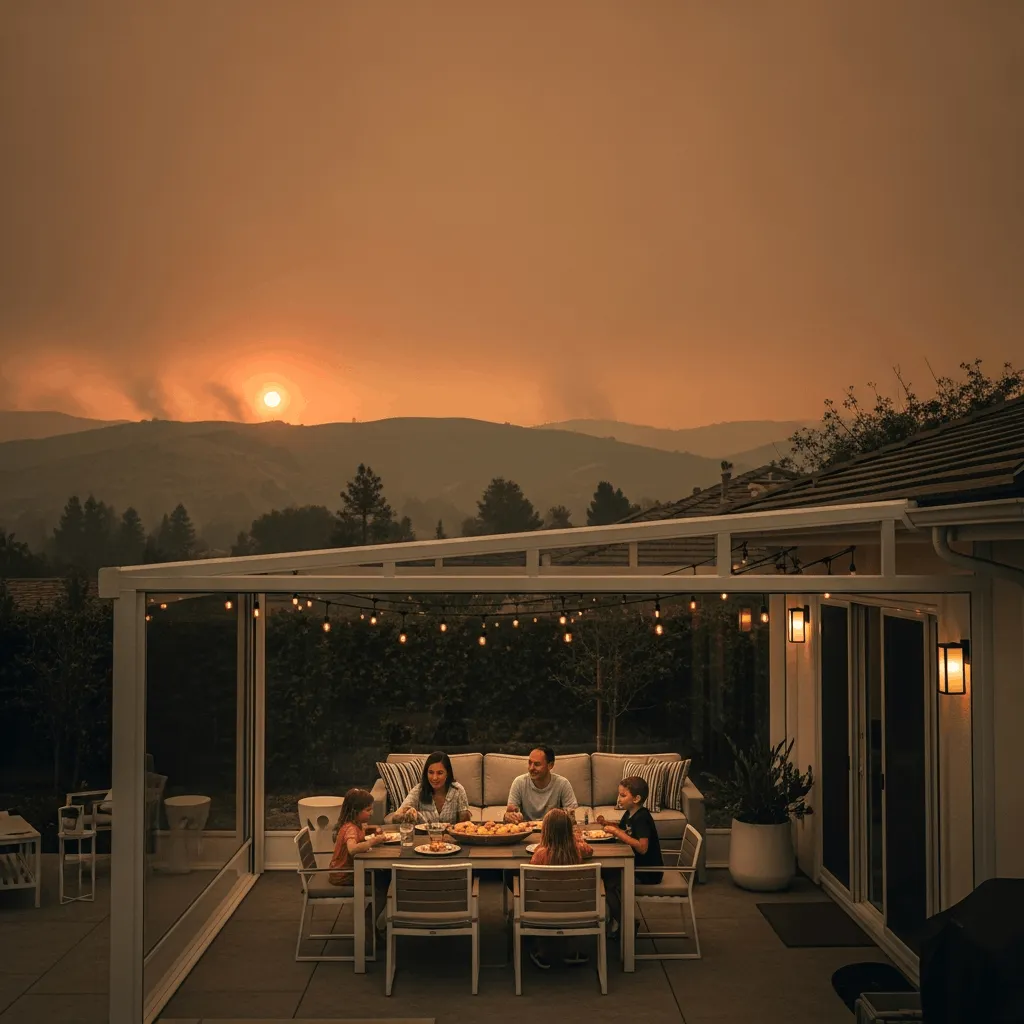
Your screens are down. The seal holds. Inside your enclosed patio, a small air purifier hums quietly, polishing the already-protected air to levels that register "Good" on the monitor you bought two fire seasons ago. The ash accumulating on cars and driveways throughout the neighborhood? It doesn't reach your outdoor furniture. The particles that send your neighbors scrambling indoors? They stop at your screens.
The strange, beautiful light of fire season filters through clear vinyl panels. You can see it. You can appreciate it. You just can't breathe it.
Dinner happens outdoors because you've created the space where it can. The kids play outside because you've made outside safe. The outdoor lifestyle that California promised — and fire season threatened — continues on your terms.
The eyelid closes — not against rain, not against wind, but against the invisible. One-Track holds the line between the air you can see and the air your lungs need. The smoke is out there. You're in here. And for the first time in fire season, that distinction means safety.
Smart Response to Air Quality
The best protection is protection that responds automatically.
One-Track's smart integration means screens can deploy when air quality deteriorates — before you check the app, before you step outside, before you realize conditions have changed. Air quality monitors, integrated with your home automation system, can trigger screen deployment the moment AQI crosses your threshold.
Air quality alerts used to control your plans. Now your screens respond to air quality alerts.
The integration works both directions. When conditions improve — when the marine layer finally arrives, when wind shifts push smoke inland, when the fires are contained and the air clears — the screens can retract automatically, returning you to open-air outdoor living the moment it's safe.
Temperature integration adds another layer of intelligence. Smoke season often coincides with California's heat waves, creating the miserable combination of dangerous air and dangerous temperatures. Smart screens can balance shade deployment for heat management with clear panels for smoke protection, optimizing your outdoor environment for multiple threats simultaneously.
The technology serves one purpose: making your outdoor space usable when conditions say it shouldn't be. The air outside does what it does. Your screens ensure you're never at its mercy.
With smart home integration, your screens can respond to air quality alerts automatically.
The Invitation
Fire season comes earlier each year, stays later, burns hotter. The orange skies that used to shock now feel routine. The smoke that used to be news now feels like weather — regular, predictable, inescapable.
Or so it seemed.
The smoke is out there. You're in here. And for the first time in fire season, that distinction means safety.
October in California. The hills brown. The sky amber. The news cycling through fire updates and air quality warnings and evacuation maps. The world outside your window looking simultaneously beautiful and hazardous, the disconnect that defines modern California life.
But on your patio, the screens are down. The air is filtered. And you're eating dinner outdoors — watching the strange, beautiful light of fire season from the one place where breathing is safe.
Not a refugee in your own home. Not trapped behind windows that stay closed for weeks. Not surrendering outdoor living to environmental conditions that grow more challenging each year. A homeowner who found the solution.
The air outside belongs to fire season. The air inside your screened patio belongs to you.
Breathe easy.